There are side dishes that quietly sit beside the main course, doing their job without asking for much attention. And then there are scalloped potatoes, the kind that somehow become the dish everyone keeps talking about. You can put a beautiful roast, a fresh salad, and a table full of other food beside them, but sooner or later someone is going back for another spoonful of those creamy, golden potatoes.
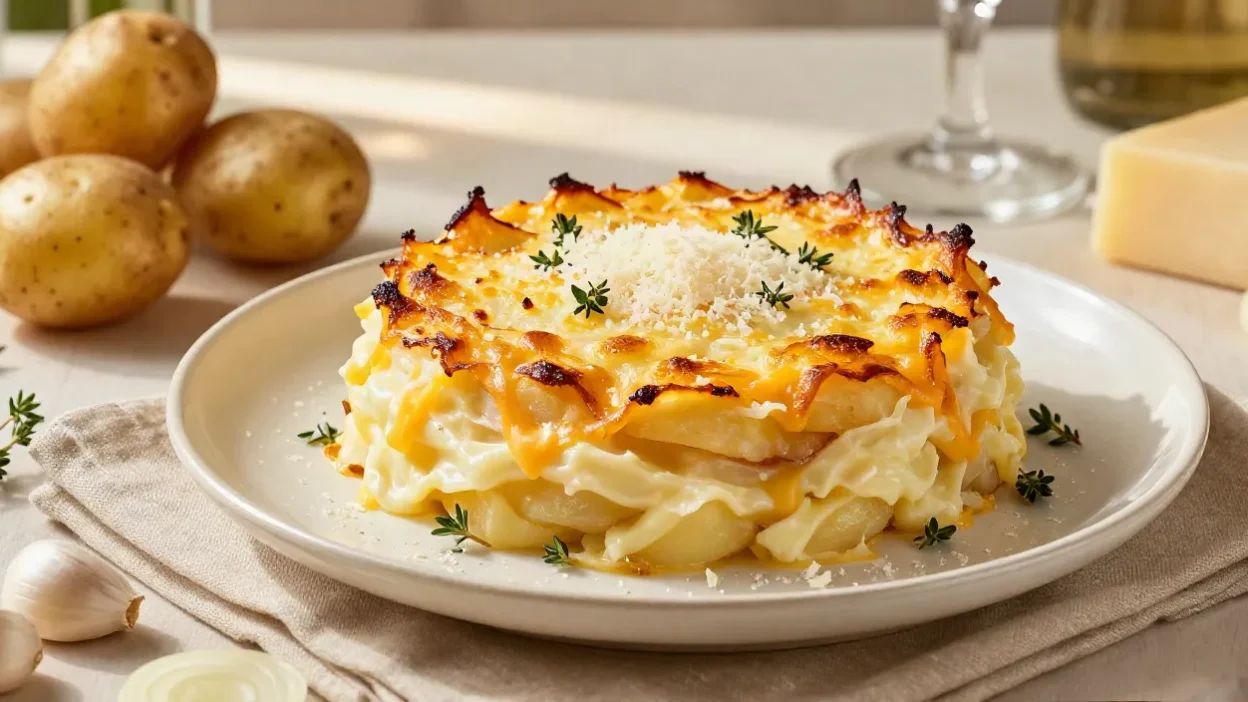
I think the combination of textures is what makes them so hard to resist. Thin slices of Yukon Gold potatoes are layered with a creamy garlic sauce, plenty of sharp cheddar, Parmesan, onion, and fresh thyme. As everything bakes, the potatoes become wonderfully tender and soak up the savory sauce, while the cheese on top turns deeply golden and bubbly. The edges get especially good, with those little crisp bits where the cheese meets the hot baking dish.
And despite how indulgent the finished dish feels, the ingredients are surprisingly familiar. There isn’t a complicated technique hiding behind it. You make a simple cream sauce, layer it with the potatoes and cheese, and let the oven take over. That’s really the beauty of it. A handful of everyday ingredients can turn into something that feels worthy of a holiday table.
I also love that these potatoes work just as well for a special gathering as they do for an ordinary Sunday dinner. They can sit beside a roast during a big family meal, but there’s nothing stopping you from making them on a chilly evening when you simply want something warm and comforting.
🥔 This dish is especially lovely for:
- Holiday dinners and family celebrations.
- Thanksgiving, Christmas, and Easter tables.
- Sunday roasts and relaxed weekend meals.
- Cozy dinners when you want something comforting.
- Potluck-style gatherings.
- Vegetarian meals served with a crisp salad or roasted vegetables.
The potatoes themselves matter more than you might expect. Yukon Gold potatoes have a naturally creamy texture and buttery flavor, which makes them particularly good here. Once sliced thinly, they cook evenly and soften into the sauce without completely losing their structure. You don’t want a pile of mashed potatoes hiding underneath the cheese. You want recognizable, tender layers that still have enough texture to make each forkful interesting.🥔✨
And then there’s the cheese. Sharp cheddar gives the dish that familiar savory flavor and melts beautifully into the sauce, while Parmesan adds a saltier, nuttier note and helps create that irresistible golden top. The cheese should be noticeable, of course, but it shouldn’t completely overpower the potatoes. You still want the garlic, thyme, onion, and creamy sauce to have their moment.
The first time you pull the baking dish from the oven is probably the hardest moment to wait through. Everything is bubbling around the edges, the top is deeply golden, and the smell of garlic, butter, cheese, and thyme has already taken over the kitchen.
It looks ready immediately.
Give it just a little time before serving.
That short rest lets the sauce settle slightly and makes the potatoes easier to scoop without everything sliding apart. It also gives you a moment to get the rest of dinner onto the table.
Why the creamy garlic sauce matters so much 🧄🥛
The sauce is where these scalloped potatoes really get their character. Rather than simply pouring cream over the potatoes and hoping for the best, this version starts with butter, onion, garlic, and flour before whole milk and stock are added. The result is creamy and flavorful, with enough body to cling to the potato slices instead of collecting at the bottom of the dish.
It starts with butter and thinly sliced onion cooked gently until the onion becomes soft and translucent. Garlic follows, and this is when the kitchen starts smelling like you’re making something much more elaborate than a potato casserole. Fresh thyme goes into the sauce too, adding a subtle herbal note that works beautifully with the richness of the dairy and cheese.
Once the onion and garlic have softened, flour is stirred into the butter to create the roux. This step doesn’t take long, but it’s important. The flour gives the sauce the structure it needs, allowing the milk and stock to become thick and velvety rather than simply soaking into the bottom of the dish.
The liquid is added gradually while whisking, which helps keep the sauce smooth. Then come the milk, stock, salt, pepper, and some of the thyme. The sauce should only reach a gentle simmer. You don’t need a furious boil here. Once it has thickened slightly and coats the back of a spoon, it’s ready.
There’s also a nice little detail with the onion. After the sauce has cooked, the onion can be strained out and layered between the potatoes rather than being left scattered across the surface. You still get all of that mellow onion flavor, but the finished top stays beautifully focused on bubbling sauce and golden cheese.
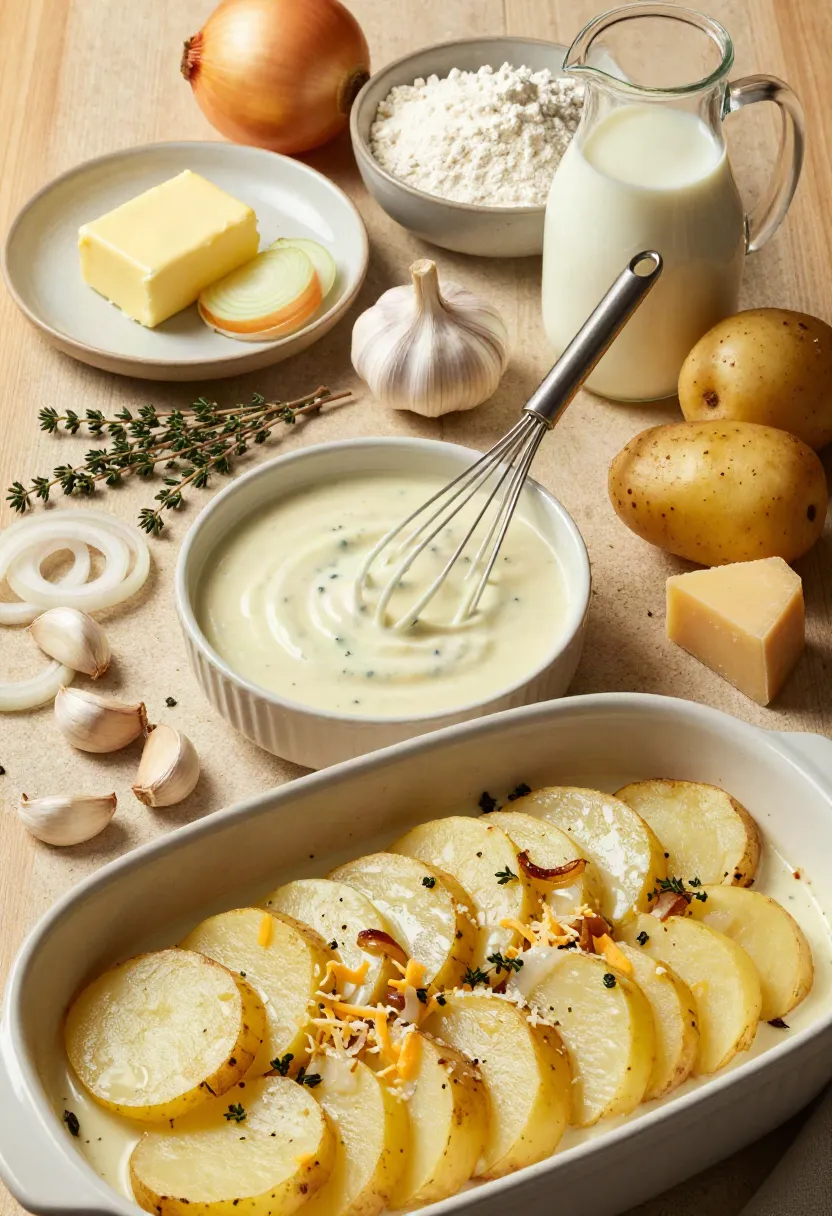
The balance of the ingredients becomes much easier to understand when you look at what each one contributes:
| Ingredient | What it brings | Texture | Flavor |
|---|---|---|---|
| Yukon Gold potatoes | The hearty base | Tender and creamy | Buttery, earthy |
| Butter | Starts the sauce and adds richness | Smooth | Rich and savory |
| Onion | Builds savory depth | Soft and delicate | Sweet and mellow |
| Garlic | Adds aromatic depth | Blends into the sauce | Warm and garlicky |
| Flour | Thickens the sauce | Velvety | Mild |
| Whole milk | Creates the creamy base | Smooth and silky | Mild and rich |
| Cheddar | Adds body and a golden top | Melty and gooey | Sharp and savory |
| Parmesan | Adds extra depth | Fine and crisp when browned | Nutty and salty |
| Fresh thyme | Lifts the richness | Delicate | Herbal and fresh |
Once the sauce is ready, the potatoes need to be layered fairly evenly. This is one of those recipes where slicing really does matter. If some potatoes are paper-thin and others are much thicker, they won’t finish cooking at the same time. Aim for thin, consistent slices so the whole casserole becomes tender together.
The layering itself is straightforward, but I wouldn’t simply throw everything into the dish and call it done. Start with half of the potatoes, then add half of the creamy sauce. The softened onion can be distributed through this layer, followed by a generous portion of cheddar and the Parmesan. Add the remaining potatoes, pour over the rest of the sauce, and finish with the remaining cheddar.
This creates several layers of flavor instead of one heavy blanket of cheese sitting over plain potatoes.
And that’s important.
The potatoes need the sauce around them, not just on top of them.
When the dish goes into the oven, the sauce bubbles gently between those layers while the potatoes absorb the garlic, thyme, butter, and cheese. By the time everything is finished, the individual ingredients have stopped tasting separate. They become one rich, savory, creamy dish.
The sauce should be thick enough to coat the potatoes but still loose enough to move between the layers. If it becomes extremely thick before the potatoes go into the oven, don’t worry, but don’t let it cook down too far either. The potatoes still need that moisture while they bake.
This is also why giving the potatoes an even slice is so useful. Each layer gets a similar amount of sauce, each slice cooks at roughly the same pace, and the finished casserole has that wonderfully cohesive texture you’re looking for.
The golden top is half the reason everyone loves them 🧀🥔
There is something about a bubbling casserole of potatoes coming out of the oven that immediately makes dinner feel more generous. You can smell the garlic before the dish even reaches the table, and the top has that deep golden color that makes it almost impossible to wait patiently.
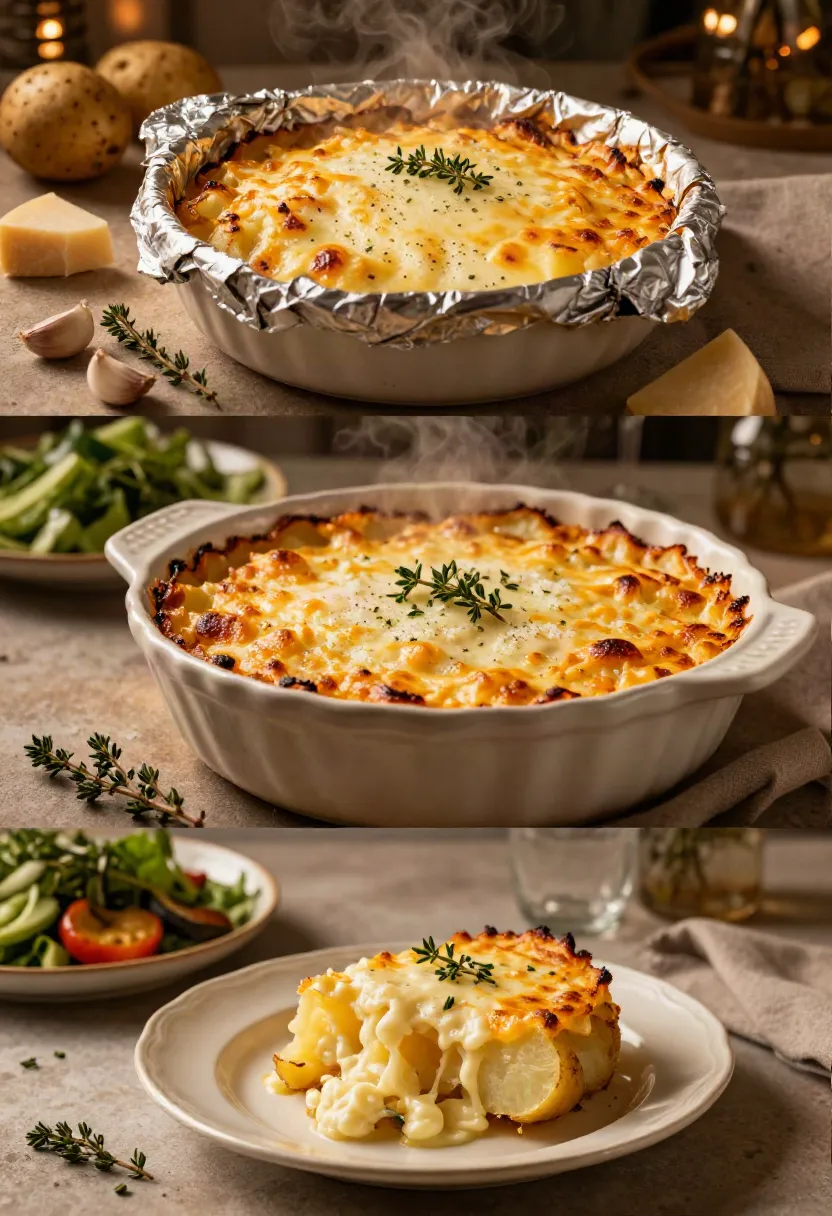
The baking happens in two stages. First, the dish is covered so the potatoes can cook gently in the creamy sauce without the cheese becoming too dark too soon. After about half an hour, the cover comes off and the casserole continues baking uncovered. That’s when the surface really starts to change.
The sauce bubbles around the edges.
The cheddar melts.
The Parmesan catches the heat.
And the top slowly develops those darker golden patches that everyone seems to want a little piece of.
You want the potatoes underneath to be completely tender before serving. A knife should slide through the layers without meeting resistance, but the potatoes shouldn’t have completely collapsed into the sauce. There should still be some definition between the slices.
Ovens can vary, and potatoes can vary too, so it’s worth paying attention to the actual texture rather than relying only on the clock. If the top is becoming too dark while the potatoes still need more time, simply cover the dish loosely again and let it continue baking.
That little bit of flexibility is useful with a recipe like this. You don’t need to panic if your casserole isn’t following the exact schedule you expected.
Once it comes out, let it sit for a few minutes before serving. Sprinkle over the remaining fresh thyme while everything is still warm. The herbs add a fresh note against all that richness and make the finished dish look just a little brighter.
🥔 A few things I always keep in mind:
- Slice the potatoes as evenly as possible so they cook at the same rate.
- Keep the sauce at a gentle simmer rather than letting it boil aggressively.
- Layer the potatoes and sauce evenly so every part cooks in plenty of moisture.
- Don’t skip the covered stage of baking.
- Check the potatoes for tenderness before deciding they’re finished.
- If the cheese browns too quickly, loosely cover the dish again.
- Let the casserole rest briefly before serving so the layers settle.
The wonderful thing about scalloped potatoes is that they don’t need much beside them. They are rich, creamy, and filling enough to make a simple dinner feel substantial, but they also know how to sit quietly next to a beautifully roasted main course.
I especially like them with something that has a little freshness or acidity. A crisp green salad, roasted vegetables, or simply some steamed greens can keep the meal from feeling too heavy. During a holiday dinner, they work particularly well with roasted meats because the creamy potatoes are almost made for soaking up those savory juices.
They also make a very practical dish for entertaining. You can prepare them ahead, let them cool, cover them well, and warm them through when you’re ready to serve. That means one less thing competing for your attention when guests are arriving and the rest of dinner is happening around you.
Still, there is something especially satisfying about eating them fresh from the oven. The top is crisp, the sauce is bubbling, and the middle is wonderfully soft. You get that contrast between browned cheese and creamy potatoes that makes the dish so comforting.
And leftovers have their own little charm.
The potatoes become even more settled after a night in the refrigerator, and a reheated portion makes an excellent side for the next day’s dinner. If you happen to have enough left for lunch, add a simple salad and you’ve got a surprisingly satisfying meal without much extra effort.
It’s comfort food in the most straightforward sense.
Nothing fancy.
Just thin potatoes, a good creamy sauce, plenty of cheese, garlic, thyme, and enough time in the oven to turn all of it into something people will quietly keep coming back to. 🥔🧀✨
Scalloped potatoes recipe 🥔🧀
These scalloped potatoes are the kind of side dish that feels much more special than the amount of work involved. Thinly sliced Yukon Gold potatoes are layered with a creamy garlic and onion sauce, sharp cheddar, Parmesan, and fresh thyme, then baked until the potatoes are tender and the top is beautifully golden.
The sauce works its way between every layer while the potatoes cook, so you don’t end up with dry potatoes underneath and all the cream sitting on top. Instead, each forkful has a little of that velvety sauce, tender potato, melted cheese, and savory garlic flavor. The browned cheese on top adds just enough crispness to contrast with the soft center.
It’s a particularly good recipe when you’re cooking for several people because you can prepare the casserole ahead of time and let the oven do most of the work. Serve it alongside roasted meat, grilled vegetables, or a simple green salad, and you’ve got a comforting meal that feels wonderfully complete.
Ingredients
For the potatoes
- 2 pounds Yukon Gold potatoes, thinly sliced
- 1 cup shredded sharp cheddar cheese
- ½ cup freshly grated Parmesan cheese
- Fresh thyme, for layering and garnish
- Salt, to taste
- Freshly ground black pepper, to taste
For the creamy garlic sauce
- 4 tablespoons unsalted butter
- 1 small yellow onion, thinly sliced
- 3 cloves garlic, minced
- ¼ cup all-purpose flour
- 2 cups whole milk
- 1 cup chicken or vegetable stock
- 1 teaspoon fresh thyme leaves
- Salt, to taste
- Freshly ground black pepper, to taste
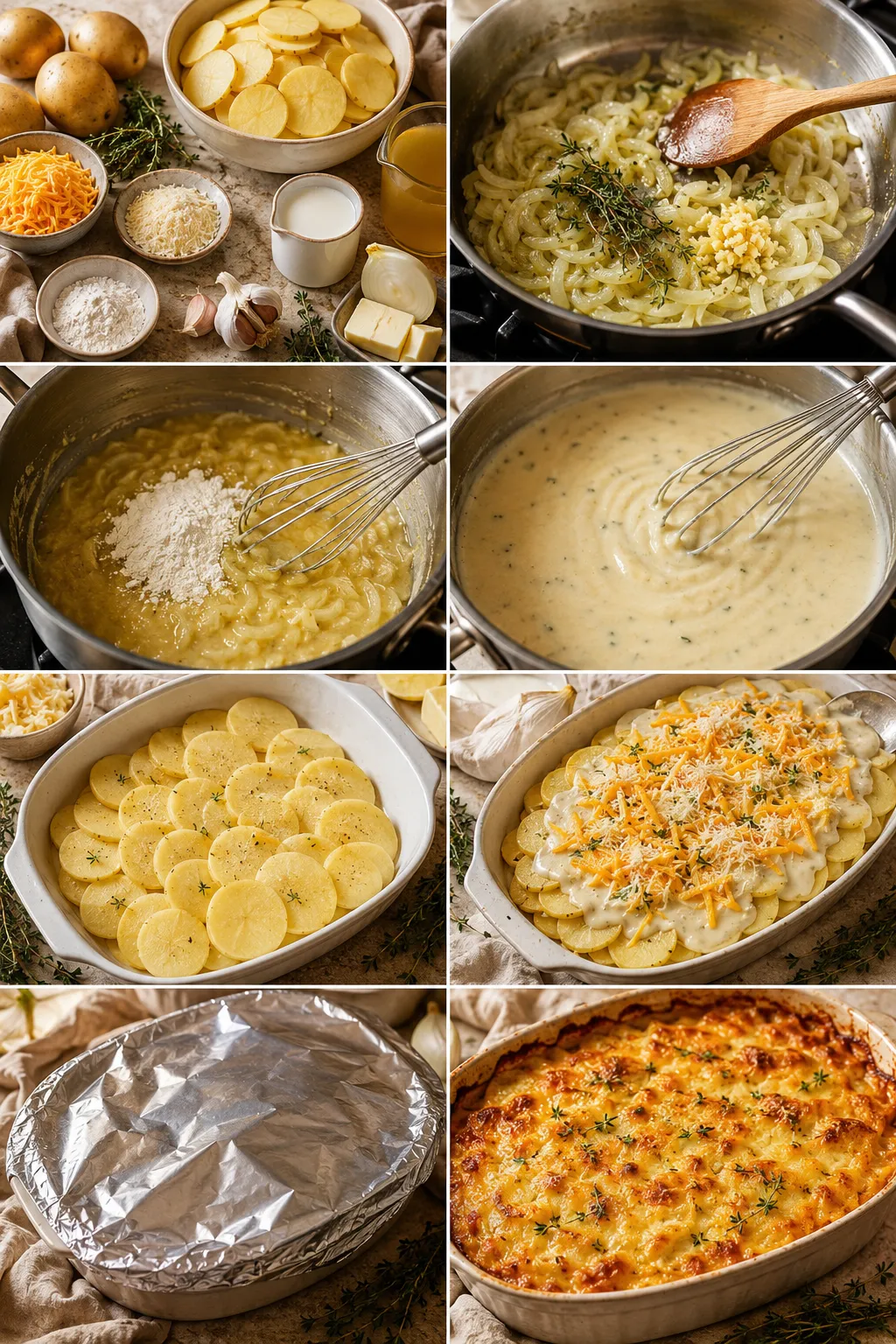
Instructions
- Prepare the potatoes.
Preheat the oven to 375°F (190°C). Peel the Yukon Gold potatoes if desired, then slice them into thin, even rounds. Try to keep the slices as consistent as possible so they cook at the same rate. Set them aside while you prepare the sauce. - Cook the onion and garlic.
Melt the butter in a saucepan over medium heat. Add the sliced onion and cook gently until softened and translucent, about 4–5 minutes. Add the minced garlic and fresh thyme and cook for another 30–60 seconds, just until fragrant. Be careful not to let the garlic brown too much. - Make the roux.
Sprinkle the flour over the butter, onion, and garlic mixture. Whisk continuously for about 1 minute, allowing the flour to cook slightly. The mixture should look smooth and paste-like without becoming dark. - Add the milk and stock.
Gradually pour in the whole milk while whisking constantly to prevent lumps. Slowly add the chicken or vegetable stock as well. Continue whisking until the sauce becomes smooth and begins to thicken. - Season the sauce.
Bring the sauce to a gentle simmer, then season with salt and freshly ground black pepper. Let it cook for a few minutes until it becomes creamy enough to lightly coat the back of a spoon. Don’t let it boil aggressively. - Prepare the baking dish.
Lightly grease a baking dish with butter or cooking spray. If you prefer a slightly more rustic presentation, there’s no need to make the bottom perfectly smooth—the layers will settle naturally as they bake. - Build the first layer.
Arrange about half of the sliced potatoes in an even layer across the bottom of the baking dish. Season lightly with salt and pepper, then spoon over about half of the creamy garlic sauce. Add some of the softened onion from the sauce if it hasn’t been strained. - Add the cheese.
Sprinkle half of the shredded cheddar and half of the Parmesan over the potatoes and sauce. Add a small scattering of fresh thyme. The cheese doesn’t need to form a completely solid layer; leaving some spaces allows the sauce to move between the potatoes. - Add the remaining potatoes and sauce.
Arrange the rest of the potato slices over the first layer. Pour the remaining creamy sauce evenly across the top, making sure it reaches the edges and works its way between the slices. Finish with the remaining cheddar and Parmesan. - Cover and bake.
Cover the baking dish tightly with foil and place it in the preheated oven. Bake for approximately 30 minutes. Keeping the dish covered during this first stage helps the potatoes steam gently and become tender without allowing the cheese to brown too quickly. - Finish uncovered.
Carefully remove the foil and return the dish to the oven. Continue baking until the potatoes are completely tender and the cheese on top is bubbling, deeply golden, and caramelized in spots. Depending on the thickness of your potato slices and your baking dish, this may take another 20–30 minutes. - Check for doneness.
Insert a thin knife into the center of the casserole. It should slide easily through the potato layers without resistance. If the top is already beautifully browned but the potatoes need more time, loosely cover the dish with foil and continue baking until tender. - Rest before serving.
Remove the scalloped potatoes from the oven and let them rest for about 10 minutes. This gives the creamy sauce a chance to settle and makes the layers easier to serve. Sprinkle with fresh thyme just before bringing the dish to the table. 🥔✨
Helpful tips 💡
- Slice the potatoes evenly so they finish cooking at the same time.
- Yukon Gold potatoes work especially well because of their naturally creamy texture.
- Keep the sauce at a gentle simmer rather than allowing it to boil hard.
- Freshly grated cheese melts more smoothly and gives the top a better texture.
- Don’t rush the covered baking stage; it helps the potatoes become tender.
- If the top browns before the potatoes are ready, loosely cover the dish again.
- Let the casserole rest before serving so the creamy layers can settle.
- Add fresh thyme at the end for a little brightness against the rich cheese and sauce.
The finished potatoes should be tender enough to cut easily with a fork, with a creamy sauce tucked between the layers and a deeply golden cheese crust on top. Serve them warm while the contrast between the soft potatoes and crisp, bubbling cheese is at its best. 🥔🧀
What to serve with scalloped potatoes 🥩🥗
Scalloped potatoes are rich enough to make a simple dinner feel special, so I usually like pairing them with something a little lighter and fresher. The creamy potatoes already bring plenty of comfort to the plate, which means the rest of the meal doesn’t need to compete with them.
A beautifully roasted chicken is an easy match. The tender meat and savory juices work especially well with the creamy potato layers, and you can spoon a little of the pan sauce over both. Roast beef, glazed ham, pork loin, or a juicy steak are equally natural companions when you’re planning a more substantial dinner.
For a lighter table, I’d go in the opposite direction. A crisp green salad with lemon vinaigrette, roasted asparagus, green beans, or simply some steamed seasonal vegetables can bring exactly the freshness the meal needs. The slight acidity from a vinaigrette is particularly nice after a forkful of rich cheese and cream.
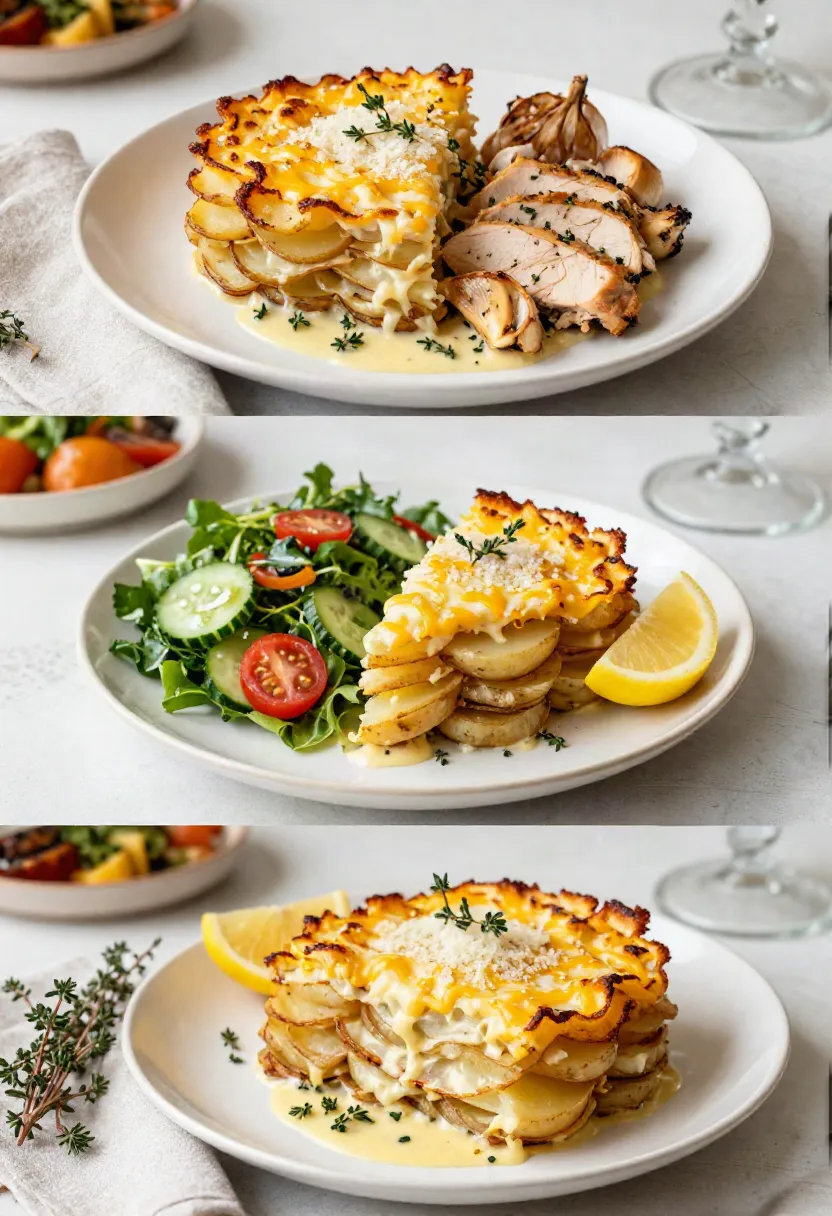
🥔 A few combinations that work beautifully:
- Roast chicken with pan juices and fresh herbs.
- Roast beef or tender beef tenderloin.
- Glazed ham for a holiday-style dinner.
- Herb-roasted pork loin.
- Grilled or roasted salmon.
- Green salad with lemon vinaigrette.
- Roasted asparagus or green beans.
- Fresh tomato and cucumber salad.
- Simple steamed seasonal vegetables.
For a holiday table, you can make the potatoes part of a larger spread with roasted vegetables, cranberry sauce, a fresh salad, and your favorite roast. They become the cozy, creamy element that ties everything together.
For a regular weeknight dinner, though, you really don’t need much. A simple roast chicken and a handful of dressed greens are enough. The potatoes are substantial enough to do most of the heavy lifting.
And if you’re serving them as part of a vegetarian meal, don’t feel like you’re missing anything. Pair them with roasted mushrooms, caramelized onions, grilled vegetables, or a big seasonal salad. The combination of potatoes, cheese, and creamy sauce already makes for a wonderfully satisfying plate. 🌿
Easy ways to make them your own 🌿🧀
Scalloped potatoes are one of those recipes that give you plenty of room to experiment. The basic combination of potatoes, creamy sauce, cheese, garlic, and herbs is wonderfully reliable, but you can easily change the personality of the dish depending on what you’re serving alongside it or what happens to be in your refrigerator.
Cheese is probably the easiest place to start. Sharp cheddar gives you that familiar bold flavor, but you could replace some of it with Gruyère for a nuttier finish or add a little smoked cheese for extra depth. Parmesan is particularly useful on top because it browns beautifully and adds a savory, salty note.
The herbs can change too. Fresh thyme is a natural choice, but rosemary, parsley, chives, or a little sage can take the dish in a different direction. I especially like keeping the herbs fairly restrained. The potatoes and cheese should still be the stars.
You can also add vegetables or other savory ingredients between the layers. Just remember that anything containing a lot of moisture should be cooked first. Otherwise, you may end up with a sauce that’s thinner than you intended.
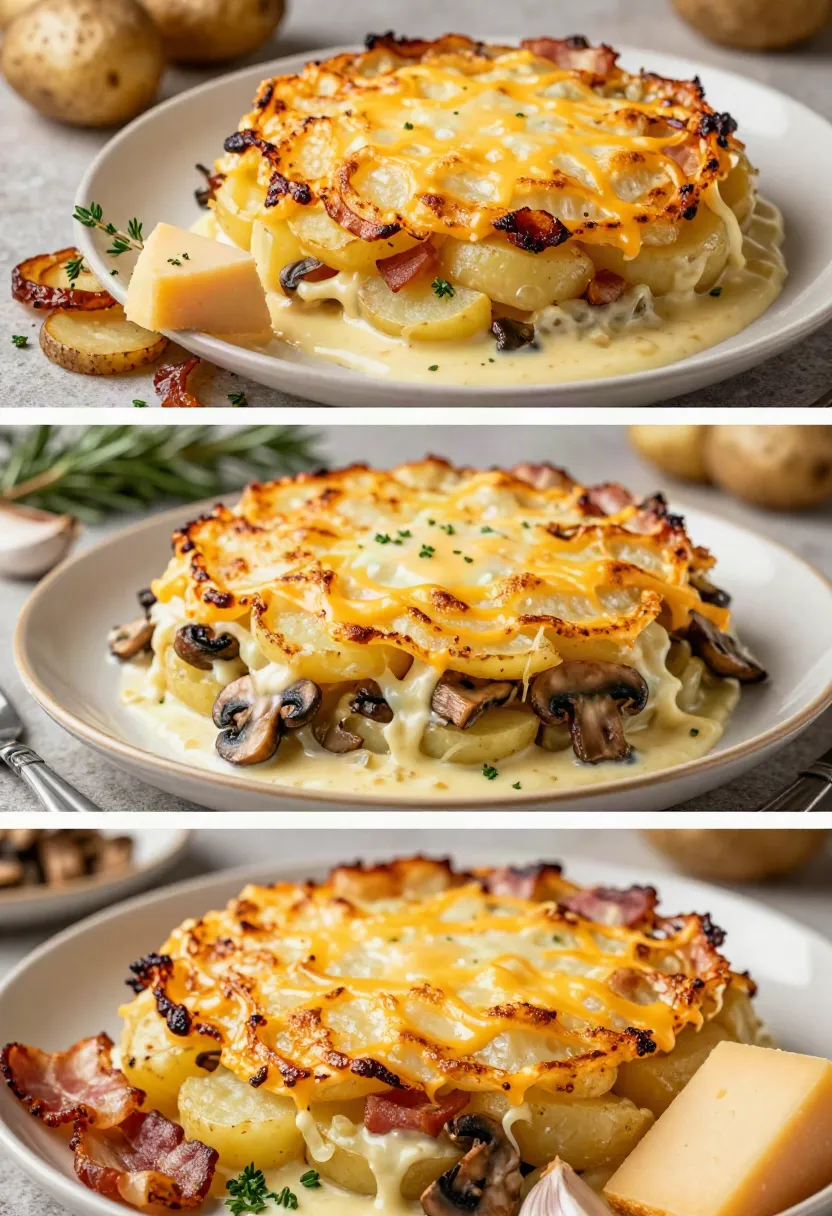
🌿 Some easy variations:
- Add caramelized onions between the potato layers.
- Mix in sautéed mushrooms for an earthy flavor.
- Add roasted garlic for a deeper, sweeter garlic note.
- Replace some cheddar with Gruyère or smoked cheese.
- Add cooked spinach or kale for extra vegetables.
- Sprinkle fresh chives or parsley over the finished dish.
- Add a little crispy bacon for a smoky, savory version.
- Try a pinch of smoked paprika for gentle warmth.
One variation I particularly like is caramelized onion and Gruyère. The sweet onions disappear beautifully into the creamy potatoes, while the nutty cheese gives the casserole a slightly more sophisticated flavor. It’s still unmistakably scalloped potatoes, just with a little extra character.
If you prefer something more rustic, bacon and cheddar are hard to argue with. The smoky bacon adds little salty pockets throughout the creamy layers, while sharp cheddar gives the whole casserole that familiar comfort-food quality.
You can even change the potatoes themselves. Yukon Gold potatoes are wonderfully creamy, but other waxy or all-purpose varieties can work too. The important thing is choosing potatoes that hold their shape reasonably well and slicing them evenly.
The best variations, though, are usually the simple ones.
A different cheese.
A handful of fresh herbs.
Some onions that needed using.
Nothing complicated.
That’s part of what makes this recipe so useful. Once you’ve made it a couple of times, you can start adjusting it almost instinctively. 🥔✨
The side dish everyone remembers 🥔✨
There are recipes that quietly do their job, and then there are recipes that somehow become the part of dinner everyone remembers. Scalloped potatoes definitely belong in the second category.
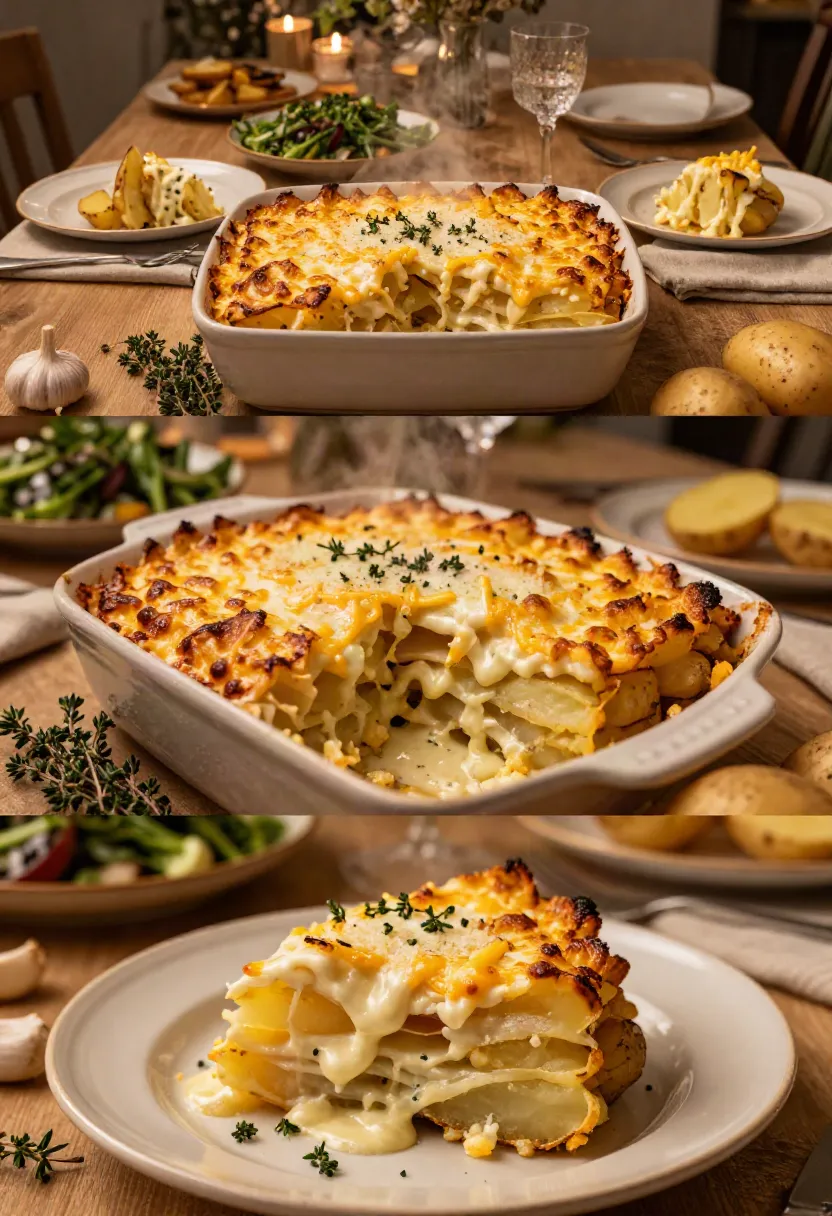
Maybe it’s the way they look when they come out of the oven. The top is golden and bubbling, the edges are wonderfully browned, and you can see the creamy sauce moving between the potato layers. It’s the kind of dish that makes people start asking when dinner is going to be served before you’ve even finished setting the table.
Then you cut into it.
The knife passes through the golden cheese and tender potatoes, revealing all those thin layers underneath. The sauce is rich and creamy, the garlic is mellow, the thyme adds a little freshness, and the Parmesan gives the top just enough savory depth.
It’s simple food, but it feels generous.
☀️ This is the kind of dish I’d happily make for:
- Christmas and holiday dinners.
- Sunday family meals.
- Thanksgiving-style gatherings.
- Cozy winter dinners.
- Dinner parties with friends.
- Potluck celebrations.
- Weekend roast dinners.
- Special occasions when you want a comforting side.
I also think scalloped potatoes are one of those dishes that become better once you stop worrying about making them look perfect. The most appealing casserole isn’t necessarily the one with perfectly arranged slices on top. It’s the one with bubbling sauce around the edges, uneven golden patches, and a few especially crisp pieces of cheese that everyone quietly hopes will end up on their plate.
And there is always that one person who goes for the corner.
You know the one.
The corner has the crispiest cheese and the most browned edges, and somehow it tastes just a little better than the middle. 🧀
That’s part of the charm.
This is food meant to be shared, spooned generously onto plates, and eaten while it’s still warm. It doesn’t need elaborate decoration or a complicated garnish. A little fresh thyme is enough.
Once you have the potatoes in the oven, the rest of dinner can be simple. Roast something, toss together a salad, pour a drink, and let the casserole do its thing. By the time everyone sits down, you’ll have tender potatoes wrapped in creamy garlic sauce and covered with that irresistible golden layer of cheese.
And if there are leftovers, don’t be too disappointed.
They make an excellent next-day side dish, and a reheated portion with a fresh salad can easily turn into a comforting lunch. In fact, having a little container of scalloped potatoes waiting in the refrigerator is one of those small things that makes the next meal feel much easier.
Some dishes are impressive because they’re complicated.
These aren’t.
They’re memorable because they’re warm, familiar, generous, and just a little indulgent.
Thin potatoes. Creamy garlic sauce. Plenty of cheese. Fresh thyme.
Sometimes that’s all you need for a side dish people keep coming back to. 🥔🧀✨