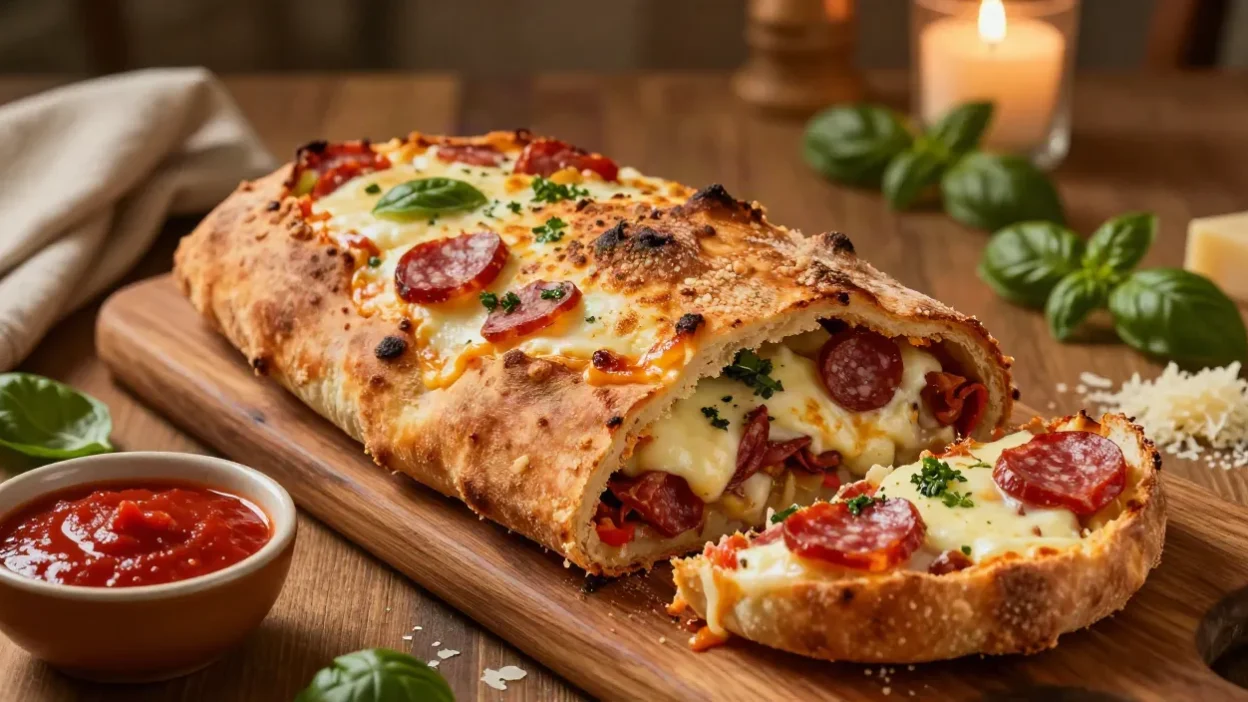
There is something about a freshly baked stromboli that feels a little more exciting than an ordinary pizza night. Maybe it is the way the golden crust hides everything inside, so you do not really know what you are getting until you slice through it. Then come those layers of melted cheese, Italian meats, fresh basil, and crisp edges, all spiraled together in one very satisfying bite.
And honestly, it looks far more complicated than it actually is.
At its heart, stromboli is simply pizza dough rolled around a generous filling and baked until the outside turns beautifully golden. The dough becomes lightly crisp around the edges while staying soft enough inside to hold all those layers together. When you cut into it, the cheese stretches between the slices, the meat sits in neat savory layers, and the whole thing suddenly looks like something you would happily order from a really good Italian bakery.
That is part of the fun. You get all the flavors you already love about pizza, but in a completely different shape.
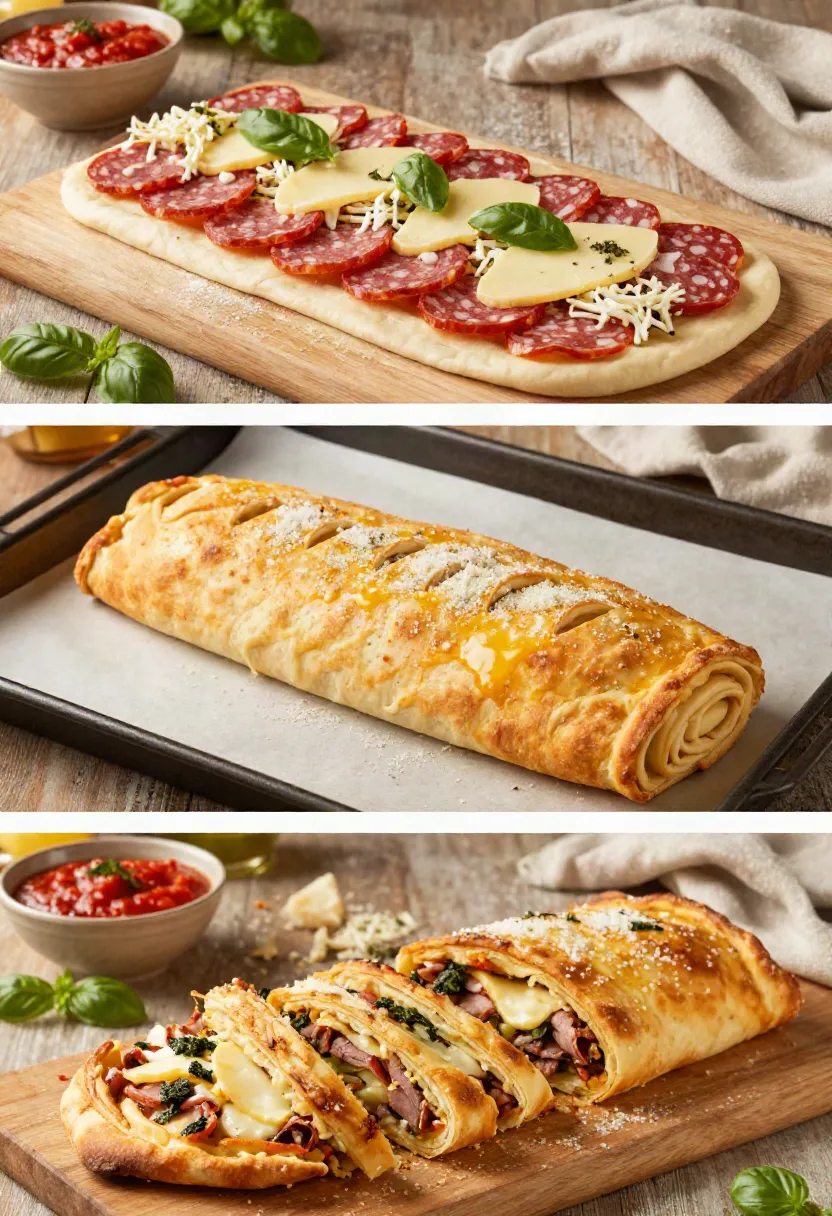
The dough is rolled into a large rectangle, brushed with garlicky butter, then layered with Italian deli meats, fresh basil, provolone, and mozzarella. Everything gets rolled up tightly, sealed, brushed with egg wash, and baked until the outside is deep golden brown. A final brush of garlic butter goes over the hot crust, adding even more flavor and making the surface smell almost unfairly good.
The best part is that you do not have to make the dough from scratch to get that effect. A good prepared pizza dough works beautifully here and makes the whole recipe much more approachable. It also means stromboli can go from “What should we have for dinner?” to a tray of bubbling, golden food without turning the evening into a major cooking project.
Once it is sliced, the spiral effect does most of the visual work for you. You see the different layers immediately, and every slice has a little bit of everything rather than one huge pocket of filling.
Serve it warm with marinara for dipping and you have the sort of dinner that tends to disappear faster than expected. It works for a relaxed family meal, a casual weekend dinner, game day, or one of those evenings when you want something comforting but still a little different from the usual pasta or pizza.
And if you have leftovers, even better. A few slices can be reheated the next day for lunch, although I would not be surprised if there are fewer leftovers than you planned.
Why stromboli is so satisfying 🍕🧀
The magic of stromboli really comes down to layers. You get several familiar ingredients, but instead of eating them separately on a pizza crust, everything is rolled together so every slice has a little bit of everything.
The combination of Italian deli meats brings plenty of savory flavor. Pepperoni adds that familiar peppery richness, while salami and soppressata bring their own slightly different textures and seasoning. Because the meats are layered rather than piled into one thick mound, they become part of the spiral and distribute their flavor throughout the roll.
Then comes the cheese, and this is where things get especially good.
Provolone gives the filling a deeper, slightly tangy flavor that works really well with the salty meats. Low-moisture mozzarella brings the stretch and melt you want from a pizza-inspired filling without adding too much moisture to the dough. Together, they create those soft, cheesy layers that become visible the second you cut into the finished stromboli.
Fresh basil plays a smaller role, but it is an important one. Its bright herbal flavor cuts through the richness of the meat and cheese, keeping the filling from feeling too heavy. As it warms inside the roll, the basil becomes fragrant and blends into the other ingredients without disappearing completely.
Then there is the garlic butter.
It is easy to look at two tablespoons of butter and think, “Sure, that sounds nice,” but this is one of those small details that makes the finished stromboli taste much more complete. The butter is mixed with dried oregano and garlic powder, then used inside and around the dough. Some goes over the dough before the filling is added, while the rest is brushed over the hot stromboli immediately after baking.
That final coating gives the crust an extra savory aroma and a slightly richer finish. It also means that when you pull the stromboli from the oven, the first thing you notice is not just the golden crust but that unmistakable garlic-and-herb smell.
Here is how the main layers work together:
| Ingredient | What it adds | What to look for |
|---|---|---|
| Pizza dough | Soft interior and crisp golden crust | Let it warm up before rolling |
| Italian deli meats | Salty, savory depth | Layer them evenly rather than piling them up |
| Provolone | Tangy, rich cheese flavor | Slice thinly for even layers |
| Low-moisture mozzarella | Stretchy, creamy melt | Helps keep excess moisture under control |
| Fresh basil | Bright herbal flavor | Use fresh leaves for the best aroma |
| Garlic butter | Richness and roasted garlic flavor | Brush inside and over the hot crust |
| Parmesan | Salty, nutty finish | Sprinkle lightly over the outside |
| Marinara | Bright, tomato-rich contrast | Serve warm for dipping |
There is also a textural reason stromboli works so well. The outside becomes golden and lightly crisp while the center stays soft and tender. The cheese melts into the layers rather than sitting in one enormous pocket, and the thin slices of meat become part of the spiral instead of making the filling feel bulky.
That balance is important.
Stromboli should feel generously stuffed, but it should still be something you can roll tightly and seal. Too much filling sounds tempting in theory, especially when you are standing there with a pile of cheese and meat in front of you, but it can make the dough difficult to roll and give all that melted cheese a few too many escape routes.
And nobody wants to spend twenty minutes carefully rolling dinner only to watch half the filling make a dramatic escape onto the baking sheet.
The little details that make the roll work ✨
Making stromboli is not difficult, but there are a few moments where small decisions make a noticeable difference. Most of them have less to do with complicated cooking techniques and more to do with giving the dough and filling the right conditions.
The first is the dough.
If you are using refrigerated pizza dough, let it sit at room temperature for at least 30 minutes before rolling it out. Cold dough tends to spring back and fight you, which makes it much harder to stretch into a large rectangle. You roll it out, it shrinks back. You roll again, it shrinks again. Suddenly you are having an argument with a ball of dough.
Letting it warm up gives the gluten time to relax. Once that happens, the dough becomes much easier to roll into the large rectangle you need for the stromboli.
The baking surface matters, too. A pizza stone or heavy metal baking sheet should be heating in the oven while you prepare the stromboli. Starting with a hot surface gives the bottom of the dough an immediate burst of heat, helping it become lightly crisp instead of pale and soft underneath.
This is especially useful because the filling naturally releases some fat and moisture as it bakes. A properly heated baking surface helps the bottom of the dough cook through rather than sitting against a cold tray while the top is already turning golden.
When you add the filling, resist the urge to pile everything into the middle. It is surprisingly easy to get carried away once you have all the meat and cheese sitting in front of you. Keep the layers fairly even and leave a clear border around the edges. The original recipe recommends leaving roughly a 1.5- to 2-inch border, which gives you enough dough to fold, roll, and seal the stromboli properly.
That border might look like wasted space while you are assembling everything, but it really is not. It becomes the part that helps hold the filling inside.
The rolling itself is also worth taking slowly. Fold the short ends inward first, then start rolling from the long side closest to you. Roll it firmly enough to create a compact spiral, but do not crush the dough or squeeze the filling out toward the edges. Once the roll is complete, pinch the long seam closed and make sure the ends are sealed as well.
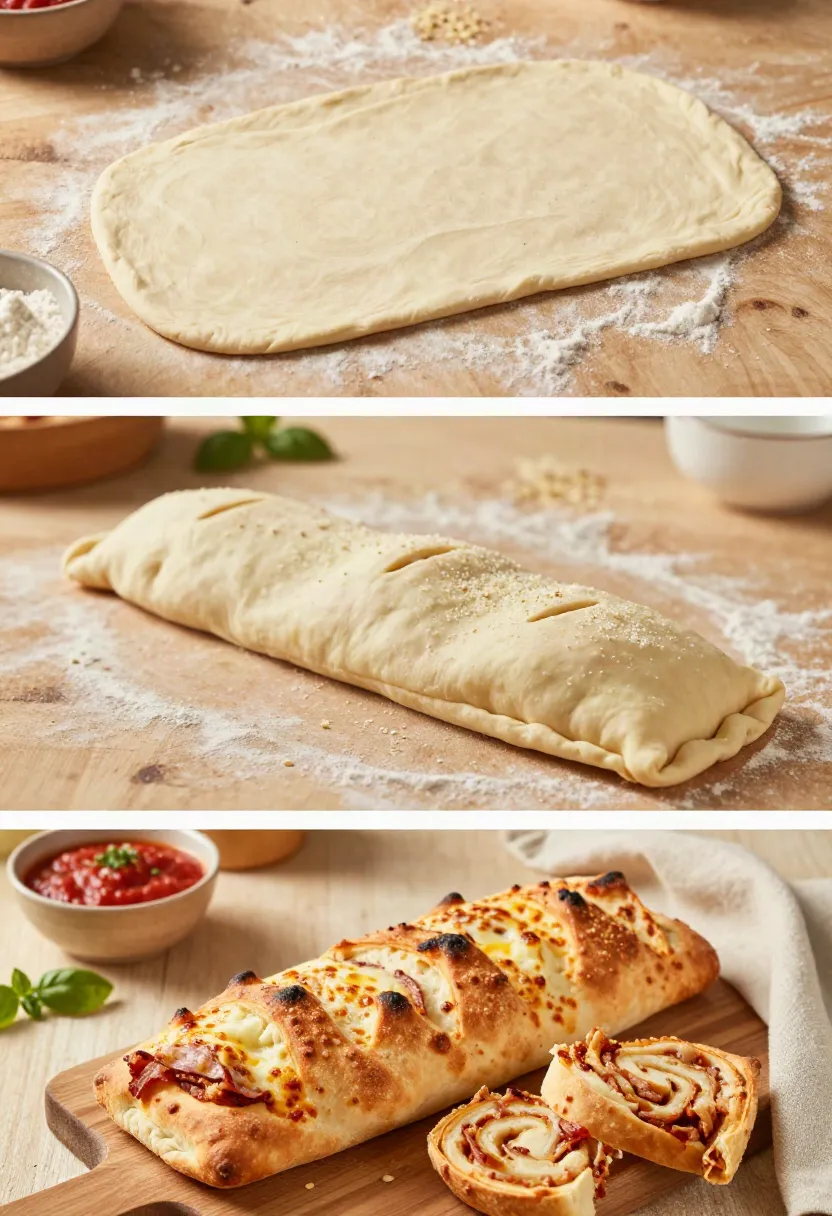
Place it seam-side down before baking. That way, the weight of the stromboli helps keep the seam closed while the dough cooks.
And do not skip the little cuts on top.
Five or six small vents allow steam to escape while the stromboli bakes. Without them, pressure can build inside the roll and push the dough apart. A few neat slits give that steam somewhere to go while also creating those little openings across the golden crust that make the finished stromboli look even more inviting.
The egg wash has a job, too. It helps seal the edges and gives the outside of the dough a beautiful golden finish as it bakes. A light sprinkle of Parmesan before the stromboli goes into the oven adds another savory layer and gives the crust a slightly more finished look.
Then comes the part that requires the most patience: waiting.
Once the stromboli is baked, it is incredibly tempting to slice it immediately. The crust is golden, the cheese is melted, and the smell is everywhere. But giving it around 10–15 minutes to rest allows the filling to settle slightly, which makes slicing much easier and keeps the cheese from sliding out of every piece.
You do not need to wait until it is cold. Just give it enough time to stop being piping hot in the center.
A few little habits make the whole process easier:
- Let refrigerated dough come to room temperature before rolling.
- Preheat the pizza stone or metal baking sheet before the stromboli goes in.
- Keep the filling in even layers and avoid overstuffing.
- Leave enough dough around the edges to create a proper seal.
- Roll tightly, but gently enough that the filling stays in place.
- Cut several small vents across the top before baking.
- Let the finished stromboli rest before slicing.
Once you get these details right, the process becomes surprisingly straightforward. The dough does not need to be perfect, the filling does not need to be arranged like a photograph, and the finished roll certainly does not need perfectly identical slices.
In fact, a little messiness is part of the charm.
The goal is a golden, crisp-edged roll with a soft center, melted cheese running through the spiral, plenty of savory meat, fresh basil tucked between the layers, and just enough garlic butter to make the whole thing smell like pizza night got a serious upgrade.
Stromboli recipe 🍕🧀
This homemade stromboli is basically everything you love about pizza, rolled into one golden, cheesy package. Soft pizza dough is layered with Italian deli meats, provolone, mozzarella, and fresh basil, then rolled tightly and baked until the crust is deeply golden and crisp around the edges.
The finishing touch is garlic butter brushed over the dough before and after baking. It sounds like a small thing, but it gives the crust so much extra flavor. Add a little Parmesan on top, slice the stromboli into thick pieces, and serve it warm with marinara sauce for dipping.
The filling is rich and savory, but the fresh basil and tomato sauce keep each bite from feeling too heavy. And because everything is rolled together, you get a little bit of crust, melted cheese, meat, and herbs in almost every slice.
This recipe makes one large stromboli, which is enough for a family dinner or a casual gathering. It is also surprisingly easy to prepare once you have the dough rolled out. The most important thing is not to overfill it and to give the finished stromboli a few minutes to rest before slicing.
Ingredients
For the stromboli:
- 1 pound pizza dough, preferably at room temperature
- ¼ cup butter, melted
- 1 teaspoon garlic powder
- 1 teaspoon dried oregano
- ¼ cup grated Parmesan cheese
- 4 ounces sliced pepperoni
- 4 ounces sliced salami
- 4 ounces sliced soppressata
- 6 ounces sliced provolone cheese
- 6 ounces low-moisture mozzarella cheese, shredded
- Fresh basil leaves
- 1 egg, beaten, for brushing
For serving:
- Warm marinara sauce, for dipping
How to make stromboli
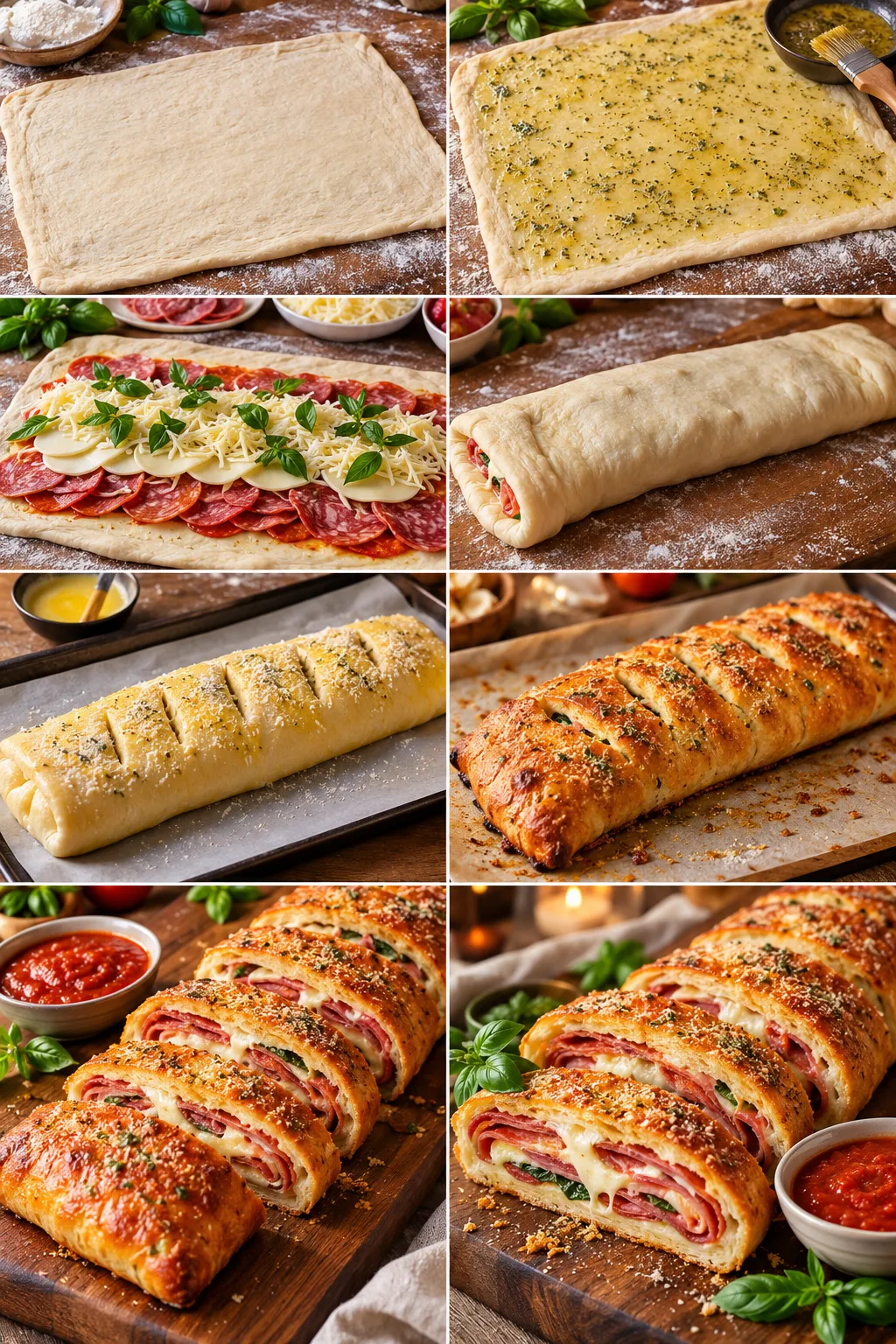
- Prepare the dough.
Remove the pizza dough from the refrigerator and let it sit at room temperature for about 30 minutes. This allows the dough to relax and makes it much easier to roll without constantly shrinking back. - Heat the oven and baking surface.
Place a pizza stone or heavy baking sheet in the oven and preheat to 425°F (220°C). Let the baking surface heat thoroughly while you prepare the stromboli. - Make the garlic butter.
In a small bowl, combine the melted butter, garlic powder, and dried oregano. Stir well and set aside. You will use this mixture both before and after baking. - Roll out the dough.
Lightly flour your work surface and roll the dough into a large rectangle, roughly 11 × 14 inches. Try to keep the thickness fairly even so the stromboli cooks consistently. - Add the garlic butter.
Brush part of the garlic butter evenly over the surface of the dough, leaving a border of about 1½–2 inches around the edges. This border will help you seal the stromboli later. - Layer the filling.
Arrange the pepperoni, salami, and soppressata evenly over the dough. Add the provolone and mozzarella, then scatter fresh basil leaves over the top. Keep the filling in relatively even layers rather than creating one very thick pile in the center. - Roll the stromboli.
Fold the short edges of the dough inward slightly. Starting from one long side, carefully roll the dough into a tight log. Try to keep the filling tucked inside as you roll. Once you reach the end, pinch the long seam firmly closed. - Seal the ends.
Pinch the ends closed as well, then gently tuck them underneath the stromboli. Place the finished roll seam-side down on a sheet of parchment paper. - Prepare the top.
Brush the surface with the beaten egg. Sprinkle the remaining Parmesan over the top, then use a sharp knife to cut about five or six small vents across the dough. These openings allow steam to escape while the stromboli bakes. - Bake until golden.
Carefully transfer the stromboli, still on the parchment, onto the preheated baking surface. Bake for about 20–25 minutes, or until the crust is deeply golden brown and the cheese inside is fully melted. - Brush with garlic butter.
Remove the hot stromboli from the oven and immediately brush the remaining garlic butter over the crust. The warm surface will absorb some of that buttery garlic flavor, making the crust even more fragrant. - Let it rest.
Allow the stromboli to rest for about 10–15 minutes before slicing. This gives the melted cheese and filling time to settle so they do not slide out as soon as you cut into it. - Slice and serve.
Use a sharp serrated knife to cut the stromboli into thick slices. Serve warm with marinara sauce on the side for dipping.
A few helpful tips 💡
- Let the dough warm up: Room-temperature dough is much easier to stretch and roll evenly.
- Do not overfill: More filling is not always better. Too much can make the stromboli difficult to seal and cause the filling to escape while baking.
- Leave a clean border: Keeping the edges free of filling gives you enough dough to create a secure seal.
- Roll firmly: A tight roll gives you a better spiral and helps keep the layers together.
- Use low-moisture mozzarella: It melts beautifully without adding too much extra moisture to the dough.
- Do not skip the vents: They allow steam to escape and help prevent the dough from splitting open.
- Rest before slicing: Those extra few minutes make a surprisingly big difference when you want neat, cheesy slices.
- Serve it warm: Stromboli is at its best when the crust is crisp, the cheese is still soft, and the filling is warm.
The slice that tells you everything 🍕✨
There is a very specific moment when stromboli finally feels finished.
It has been sitting on the counter for a few minutes, the crust has started to lose that intense oven heat, and you take the knife to the center. The crust gives way with a soft crack, and suddenly the whole structure of the roll is visible.
That first slice is always the interesting one.
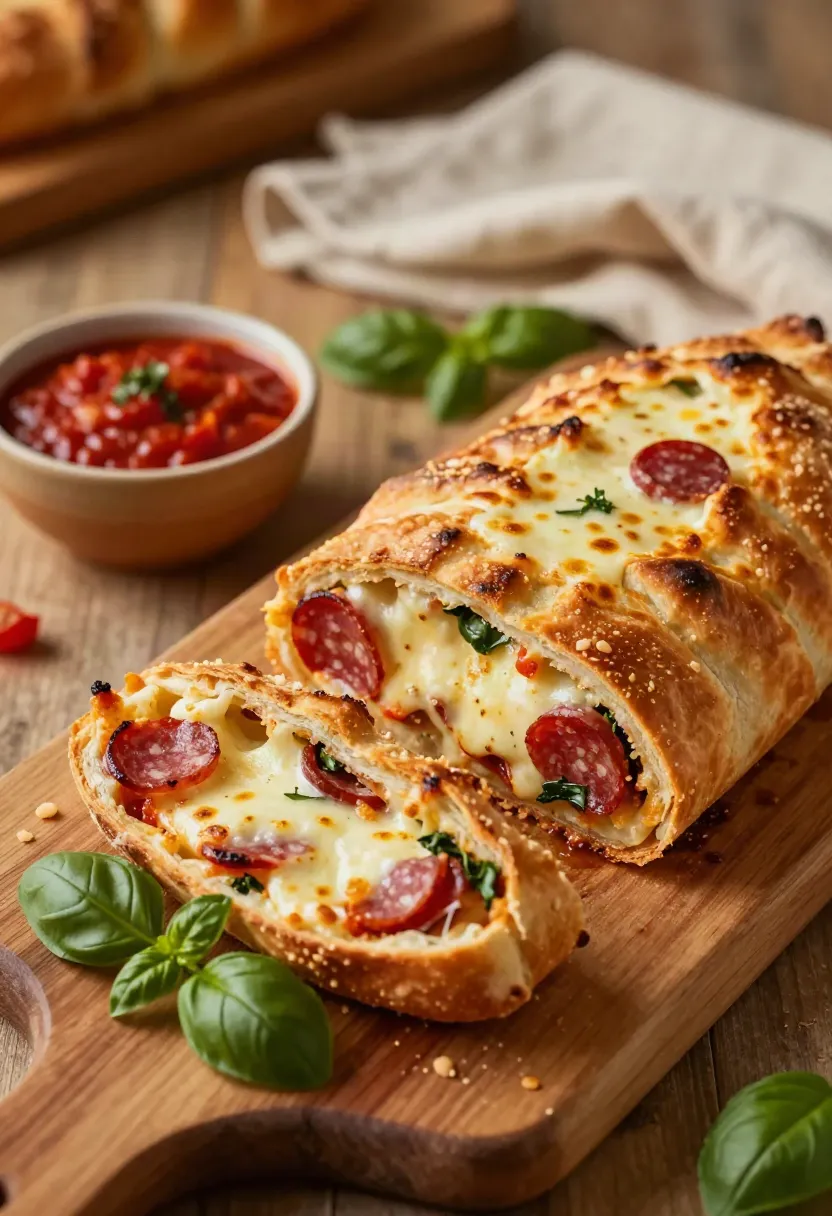
You can see the layers of pepperoni and salami tucked between melted cheese, little green pieces of basil, and that golden dough wrapped around everything. If you rolled it tightly enough, the filling creates a loose spiral that makes every slice look slightly different. Some pieces might have a little more mozzarella. Another might catch a generous piece of pepperoni right in the middle. The end pieces will usually have more crust, which is not exactly a bad thing.
In fact, I would argue that the ends deserve a little more respect.
They have that extra bit of golden dough around the filling, and the edges tend to become slightly crispier in the oven. If you are someone who always looks for the crispiest corner of a pizza, there is a good chance you will quietly claim one of the end slices before anyone else gets the chance.
That is part of what makes stromboli more fun than a standard pizza.
With pizza, you usually know exactly what each slice is going to look like. With stromboli, there is a small element of surprise. You roll everything up, seal the edges, and let the oven do its thing. The first cut is when you finally get to see how all those layers came together.
And then there is the cheese.
If you slice it while it is still warm but not scorching hot, the mozzarella should still have that soft, stretchy quality without completely falling out of the roll. The provolone adds a slightly sharper note underneath it, while the salty meats keep the whole thing deeply savory. Fresh basil sits between those richer ingredients and adds just enough freshness to keep the flavor from becoming too heavy.
This is also why I like cutting stromboli into fairly thick slices rather than making them too thin. You want each piece to have enough structure to hold itself together. A good slice should be easy to pick up, dip into marinara, and eat without needing a fork and knife.
And the marinara really does belong on the side.
The tomato sauce brings acidity and brightness to the rich filling, which makes the whole bite feel more balanced. You can dip the edge of each slice into the sauce, add a little extra to the plate, or simply leave the sauce nearby for anyone who wants it.
There is something very satisfying about that first bite: crisp crust, soft dough, melted cheese, salty meat, fresh basil, and a little tomato sauce on the side.
It is pizza, technically.
But it feels like something else entirely.
Maybe that is because stromboli gives you a little more contrast in every bite. There is the soft center and crisp exterior, the rich cheese and bright tomato sauce, the salty meat and fresh basil. Even the shape makes a difference. You are not eating one flat layer of toppings. You are eating several layers rolled tightly into one warm, golden package.
And once you see that first spiral, you understand why the extra few minutes of rolling and sealing were worth it.
Make the spiral your own 🌿🧀
Once you have made stromboli once, it becomes one of those recipes that is surprisingly easy to personalize.
Not because you need to reinvent it. Quite the opposite. The basic structure is so dependable that you can change one or two elements and still end up with something that feels like the same dish.
Maybe you prefer a little more heat. Add spicy Italian sausage or a few thin slices of hot pepper alongside the deli meats. A sprinkle of crushed red pepper inside the roll can also bring a gentle warmth without taking over the whole filling.
Or go in a completely different direction and make the filling more herb-forward. Fresh basil is wonderful, but you can add a little chopped parsley, oregano, or even a thin layer of pesto. The important thing is to avoid adding too much wet filling, since excess moisture can make the dough harder to bake properly.
You can also change the cheese depending on what kind of stromboli you want that night.
A little fontina makes the center especially creamy. Sharp provolone gives it more bite. Part-skim mozzarella keeps things a little lighter, while a combination of mozzarella and Parmesan creates a more pronounced savory flavor.
The same idea works with the meat. You do not have to use exactly the same combination every time. If you love pepperoni, let it take the lead. If salami is your favorite, build the filling around it. You could also experiment with a little cooked Italian sausage, as long as it is fully cooked and cooled before it goes into the dough.
The trick is to think in contrasts rather than simply adding more ingredients.
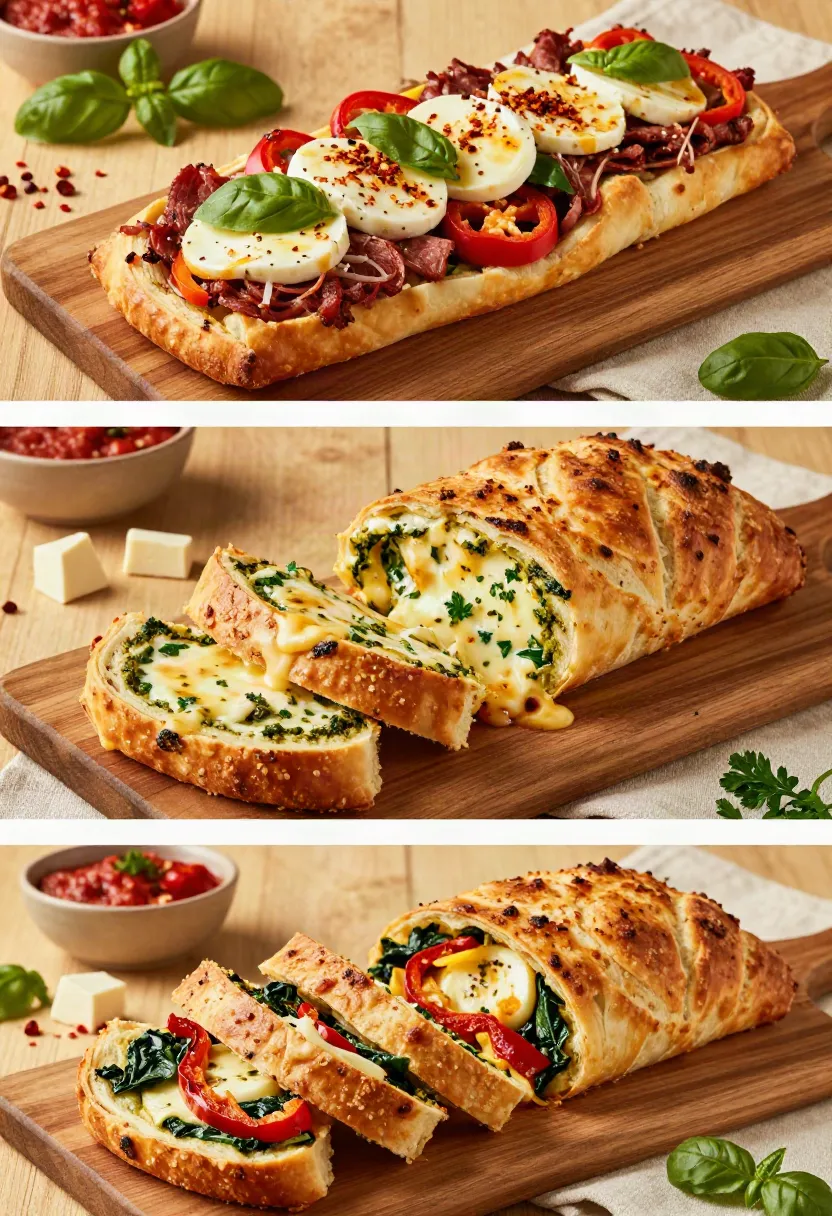
A few easy directions to try:
- For more heat: add crushed red pepper, hot peppers, or spicy Italian sausage.
- For a fresher flavor: add extra basil, parsley, or a small amount of pesto.
- For a richer filling: swap some of the mozzarella for fontina or extra provolone.
- For deeper garlic flavor: add a thin layer of roasted garlic before adding the cheese.
- For a smoky twist: use a little smoked mozzarella with the regular cheese.
- For a vegetable version: add thinly sliced roasted peppers or well-drained spinach.
- For extra crunch: add a small amount of finely chopped pepperoncini or roasted vegetables.
- For a more herby filling: mix fresh basil with a little dried oregano and parsley.
The important part is not to change everything at once.
Keep the dough, rolling method, and baking temperature the same. Change the cheese one time. Add roasted peppers another time. Try a little extra heat the next time you make it.
That way, you actually learn what you like instead of ending up with a roll containing twelve different ingredients that are all competing for attention.
And honestly, stromboli does not need twelve ingredients.
There is something to be said for keeping the filling simple enough that you can still taste each component. Good pizza dough, flavorful meat, two cheeses, fresh basil, garlic butter, and marinara already give you plenty to work with.
You can also make the stromboli feel different simply by changing how you serve it.
Cut the slices thick and serve them as the main dinner. Make smaller slices and put them on a platter for a party. Add a few bowls of different dipping sauces if you are feeding a crowd. Or cut leftovers into smaller pieces and reheat them for a very satisfying lunch.
The recipe stays the same.
The occasion changes.
And that is one of the reasons I like recipes like this. They give you enough structure to make the first attempt easy, but they leave plenty of room for you to eventually stop following the recipe word for word and start making it your own.
When dinner becomes the best part of the evening ❤️
Some recipes are made because you need to get dinner on the table.
Others somehow turn dinner into an event.
Stromboli belongs in the second category.
Not because it is fancy. It really is not. It is pizza dough and filling, rolled together and baked. But there is something about putting a whole golden roll in the middle of the table and letting everyone wait for it to be sliced that makes the meal feel a little more special.
It is the kind of food that encourages people to linger.
Someone takes the first slice. Someone else immediately asks for the end piece because they want the extra-crispy crust. The marinara gets passed around. There is usually a moment when everyone is comparing which slice has the best cheese-to-meat ratio.
And then, somehow, the first half is gone.
That is when stromboli really makes sense as a recipe. It is not trying to be delicate or complicated. It is warm, generous food designed to be shared.
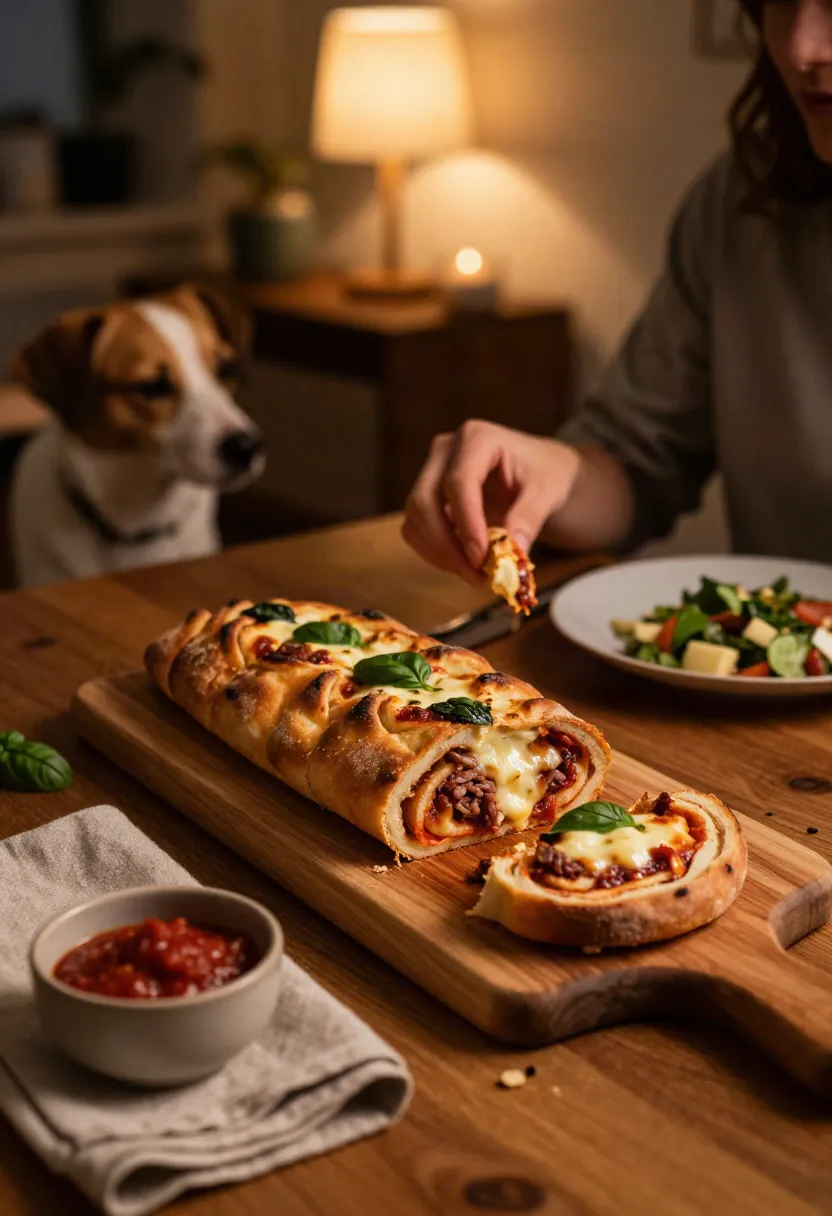
You can make it for:
- a relaxed Friday night dinner when everyone is hungry
- a casual weekend lunch that needs very little fuss
- game-day gatherings where people can grab slices as they pass
- family movie nights when nobody wants a formal meal
- a table full of friends who have arrived with very serious appetites
- those evenings when takeout sounds tempting but you want something homemade instead
And because it slices so easily, it has that rare quality of being both dinner and something people can casually pick at. Put the cutting board in the middle of the table, add a bowl of warm marinara, and let everyone take what they want.
There is no need to make the table look perfect.
A wooden board covered with warm slices, a bowl of red sauce, a few napkins, and maybe a simple salad on the side are more than enough. Stromboli already brings plenty of personality to the table.
It also works particularly well when you are feeding different appetites. Someone can take one small slice and come back later. Someone else can take three pieces immediately. The end pieces can go to the people who love extra crust, while the middle slices usually win over anyone who is there mainly for the cheese.
And somehow, nobody seems to mind that the slices are not perfectly identical.
That is another little advantage of homemade stromboli. It is meant to look handmade.
There is something wonderfully comforting about knowing exactly what is inside that golden crust. You made the roll. You chose the filling. You watched it turn from a plain piece of dough into something that smells like garlic, melted cheese, herbs, and warm bread.
That transformation is probably my favorite part.
Because by the time you are sitting down with a hot slice of stromboli and a little marinara on the side, you are no longer thinking about whether the dough rolled into a perfect rectangle or whether every slice looks identical.
You are just eating dinner.
And sometimes that is exactly what a good recipe should give you: not another complicated project, but something warm in the middle of the table, a few people reaching for another slice, and that very satisfying feeling that you made something worth sharing.
There are recipes that impress people because they are elaborate. Stromboli does it in a much simpler way.
It arrives at the table looking golden and inviting. Someone cuts into it and reveals the spiral. The cheese is still warm. The crust smells like garlic and oregano. A bowl of marinara is waiting beside it.
And suddenly, nobody is in much of a hurry anymore.
Save the fancy dinner for another night.
Tonight, make the stromboli.