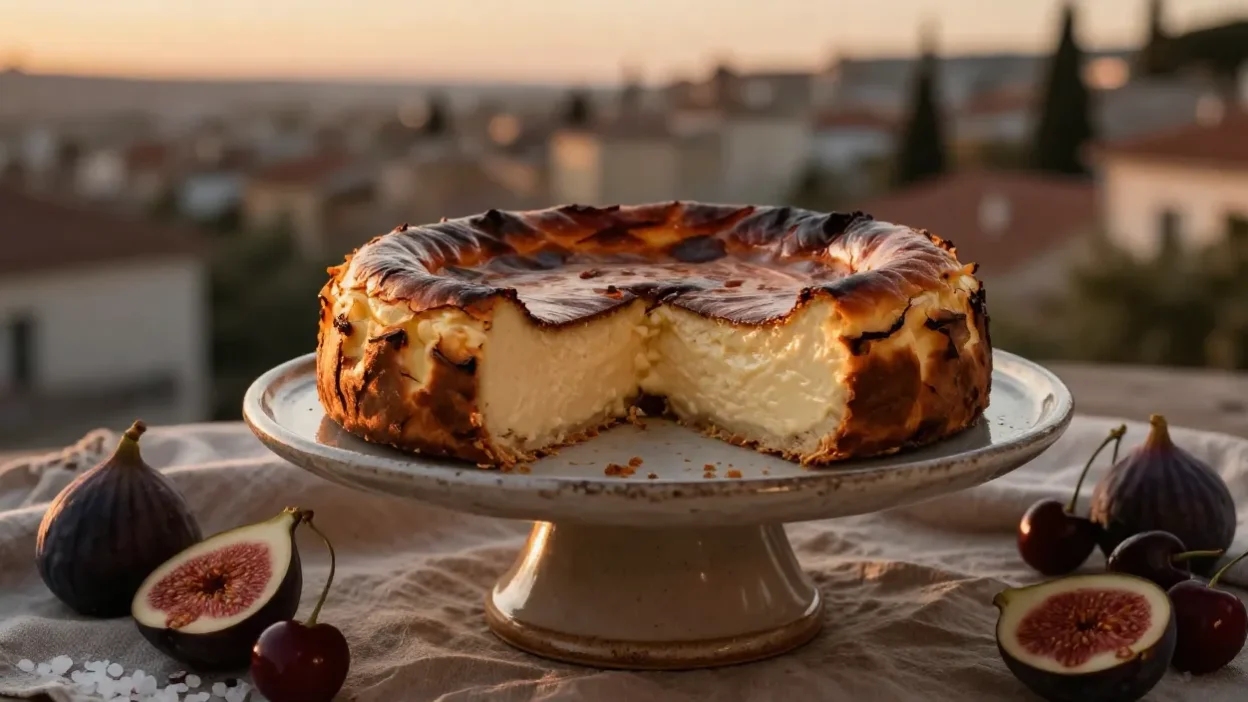
The first thing people usually notice about Basque burnt cheesecake is the color. It’s dark. Not “golden brown” the way most baking recipes politely suggest. The top looks deeply caramelized, almost scorched around the edges, and the center still moves when the pan comes out of the oven. If you’ve spent years trying to avoid cracks and uneven baking in cheesecakes, this recipe feels completely backwards the first time you make it.
And honestly, that’s why people end up loving it. 🍰
Basque burnt cheesecake — or tarta de queso as it’s called in Spain — comes from the Basque region, where restaurants have served their own versions for decades. Unlike classic American cheesecake with a biscuit crust and dense filling, this one is intentionally rustic. No crust. No water bath. No perfectly smooth surface. The cheesecake rises dramatically in the oven, darkens quickly on top, then slowly sinks while cooling into something rich, creamy, and almost custard-like in the center.
The strange part is how comforting it feels once you stop trying to control every detail.
I remember cutting into my first properly baked Basque cheesecake after letting it cool overnight in the fridge. The knife slid through the middle almost too easily. The inside stayed soft and silky while the top had this slightly bitter caramel edge that balanced all the richness underneath. It tasted expensive in that restaurant-dessert kind of way, except the ingredient list was ridiculously simple.
That’s probably the reason the recipe exploded online. It looks dramatic, but it’s actually forgiving. Maybe more forgiving than almost any other cheesecake recipe out there.
And the more imperfect it looks, the more authentic it feels. ✨
What I like most is that Basque cheesecake doesn’t pretend to be delicate or polished. Some desserts almost feel stressful before you even start baking them. Layers have to stay even. Frosting has to look smooth. Decorations slide around if the kitchen gets too warm. Basque cheesecake feels calmer than that.
You pour the batter into a wrinkled pan lined with parchment paper, bake it hotter than seems reasonable, then trust the process while the top darkens dramatically in the oven.
And somehow, despite looking slightly chaotic during every stage of baking, it comes together beautifully in the end.
There’s also something cozy about the way people usually serve it. No giant pile of whipped cream. No complicated garnish work. Maybe coffee on the side. Maybe berries if they’re in season. Most of the time, the cheesecake simply carries itself.
That confidence kind of suits the dessert.
Why Basque cheesecake tastes completely different from traditional cheesecake
A lot of people expect Basque cheesecake to taste similar to New York cheesecake the first time they try it. Both use cream cheese. Both bake in springform pans. Both technically belong to the cheesecake category.
But the texture changes everything.
Traditional cheesecake usually aims for structure. Dense filling. Smooth slices. Clean edges. Even baking from center to crust. Basque cheesecake goes in the opposite direction and almost ignores those rules entirely. The oven temperature stays very high, which darkens the surface quickly before the inside fully firms up. That contrast creates the signature texture: deeply caramelized outside, soft creamy center.
The flavor changes depending on how dark you let the top become too. A lighter Basque cheesecake tastes sweeter and milkier. A darker one develops stronger caramel notes with a slight bitterness that cuts through all the richness.
That balance matters because the cheesecake itself is incredibly rich already. Between the cream cheese, eggs, and heavy cream, it could easily become overwhelming. The dark top fixes that somehow.
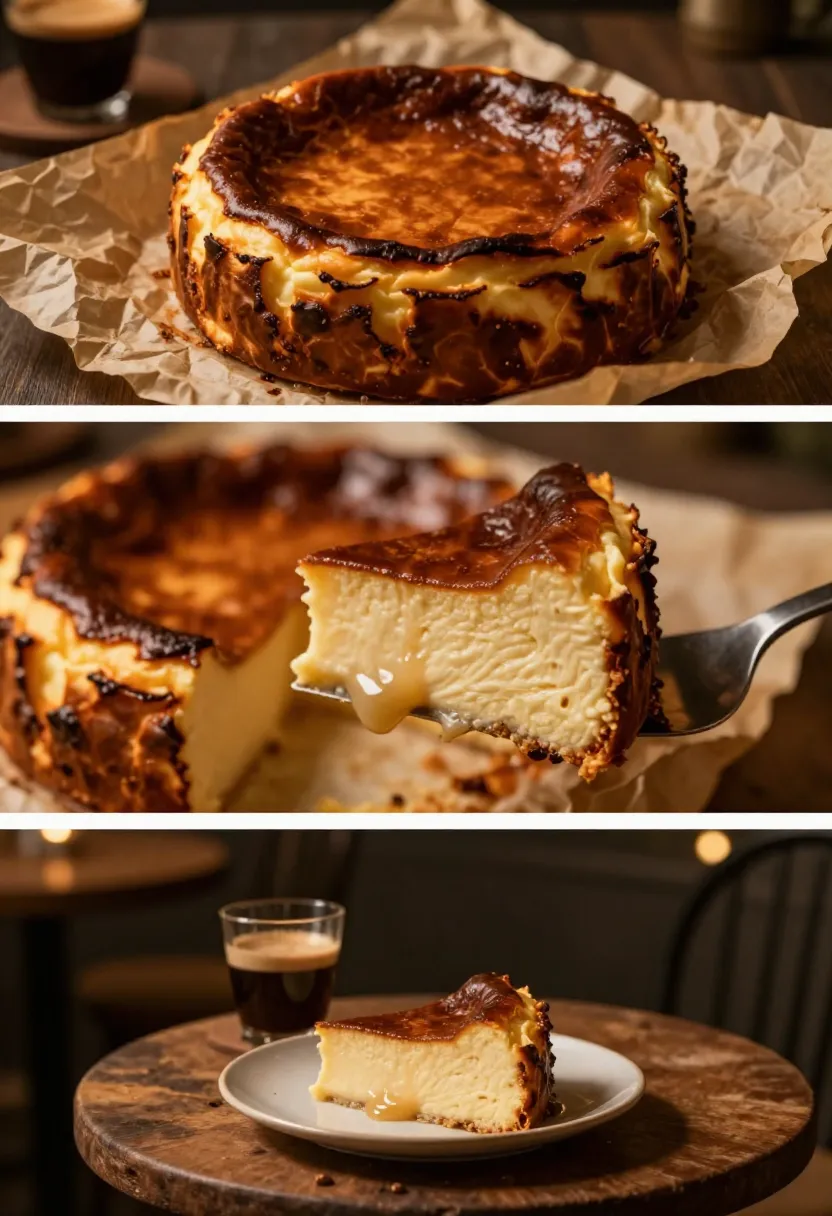
Another thing people don’t expect is how much the texture changes after chilling. Fresh from the oven, the middle feels almost molten. After several hours in the fridge, it settles into something smoother and silkier without turning heavy.
And weirdly enough, the cheesecake tastes even better the next day. 🕯️
The flavors deepen overnight while the center becomes more stable for slicing. That’s why Basque cheesecake works so well for dinner parties or weekends when you want dessert already waiting in the fridge.
A few reasons people keep making it:
- it looks impressive without complicated decorating
- the ingredient list stays simple
- the texture feels lighter than classic cheesecake
- mistakes barely matter
- it works both warm and chilled
There’s also something refreshing about a dessert that doesn’t punish you for small imperfections.
Because honestly? Most cheesecakes are stressful.
This one isn’t.
Another reason people fall in love with Basque cheesecake is the contrast between temperatures and textures. Slightly warm slices feel soft and almost mousse-like near the center, while fully chilled slices become richer, smoother, and more structured. It almost feels like two different desserts depending on when you eat it.
Some people love the middle barely set, almost spoonable in the center. Others bake it slightly longer so the filling becomes firmer and more traditional. That flexibility makes the recipe feel more personal than strict.
And unlike many cheesecakes, Basque cheesecake somehow tastes less sweet even though it’s still incredibly rich. The caramelized top changes the balance completely. The slight bitterness cuts through the creaminess and keeps every bite from becoming too heavy.
That’s why one slice usually turns into two before people realize it.
Especially late at night with coffee. ☕
The ingredients are basic, but small details change the final texture 🧈
One reason Basque cheesecake became so popular is that the ingredient list looks surprisingly short for something that tastes this rich. No complicated fillings. No gelatin. No crust mixture. No separate toppings required.
But the proportions matter more than people realize.
Too much flour and the cheesecake loses that creamy center. Too many eggs and the texture becomes slightly too firm and eggy. Even the type of cream cheese changes the final result more than expected.
Here’s a closer look at how every ingredient changes the cheesecake during baking:
| Ingredient | Purpose in the cheesecake | How it affects texture | Extra notes |
|---|---|---|---|
| Cream cheese | Creates the base of the cheesecake | Gives the filling its rich, dense, creamy texture | Full-fat cream cheese works best here. Low-fat versions make the cheesecake thinner and less silky. |
| Heavy cream | Softens the filling and adds richness | Keeps the center smooth and slightly custardy | Heavy cream helps prevent the cheesecake from feeling too dense after chilling. |
| Eggs | Help the cheesecake rise and set while baking | Create structure without making the cake dry | Too many eggs can make the cheesecake taste overly eggy and firm. |
| Granulated sugar | Sweetens the cheesecake and caramelizes the top | Helps create the dark glossy surface during baking | The sugar also balances the tanginess of the cream cheese. |
| All-purpose flour | Stabilizes the batter slightly | Helps the cheesecake hold its shape after cooling | Only a small amount is needed so the center stays creamy. |
| Vanilla extract | Adds warmth and depth to the flavor | Softens the sharp cream cheese flavor slightly | Vanilla gives the cheesecake a more rounded dessert flavor overall. |
| Sea salt | Balances sweetness and richness | Makes the caramel notes taste deeper and less flat | Flaky sea salt on top right before serving tastes especially good. |
| Parchment paper | Prevents sticking and shapes the rustic look | Creates the signature wrinkled edges | The messy folds are actually part of the traditional appearance. |
| High oven temperature | Quickly caramelizes the surface | Keeps the center softer while darkening the top | Basque cheesecake depends on high heat for its signature look and flavor. |
| Cooling time | Allows the cheesecake to fully settle | Changes the center from loose to silky | The cheesecake tastes even better after several hours in the fridge. |
| Chilling overnight | Deepens the flavor and firms the texture slightly | Makes cleaner slices while keeping the center creamy | Many people prefer Basque cheesecake the next day for this reason. |
| Dark caramelized top | Adds contrast to the sweet filling | Creates a slight bitterness that balances richness | The darker top is intentional — not a baking mistake. |
Room temperature ingredients matter here more than in most cakes. Cold cream cheese stays lumpy forever, and overmixing to fix those lumps usually whips too much air into the batter.
That extra air sounds harmless until the cheesecake rises dramatically in the oven and then collapses too aggressively later.
Not that a little sinking is bad. Basque cheesecake is supposed to fall slightly while cooling. That uneven center is part of the whole visual identity of the dessert.
I also think people underestimate how much parchment paper affects the final look. The wrinkled edges create those dramatic folds around the cheesecake while baking. Some bakers try pressing the paper perfectly smooth into the pan, but honestly, the messy version usually looks more authentic.
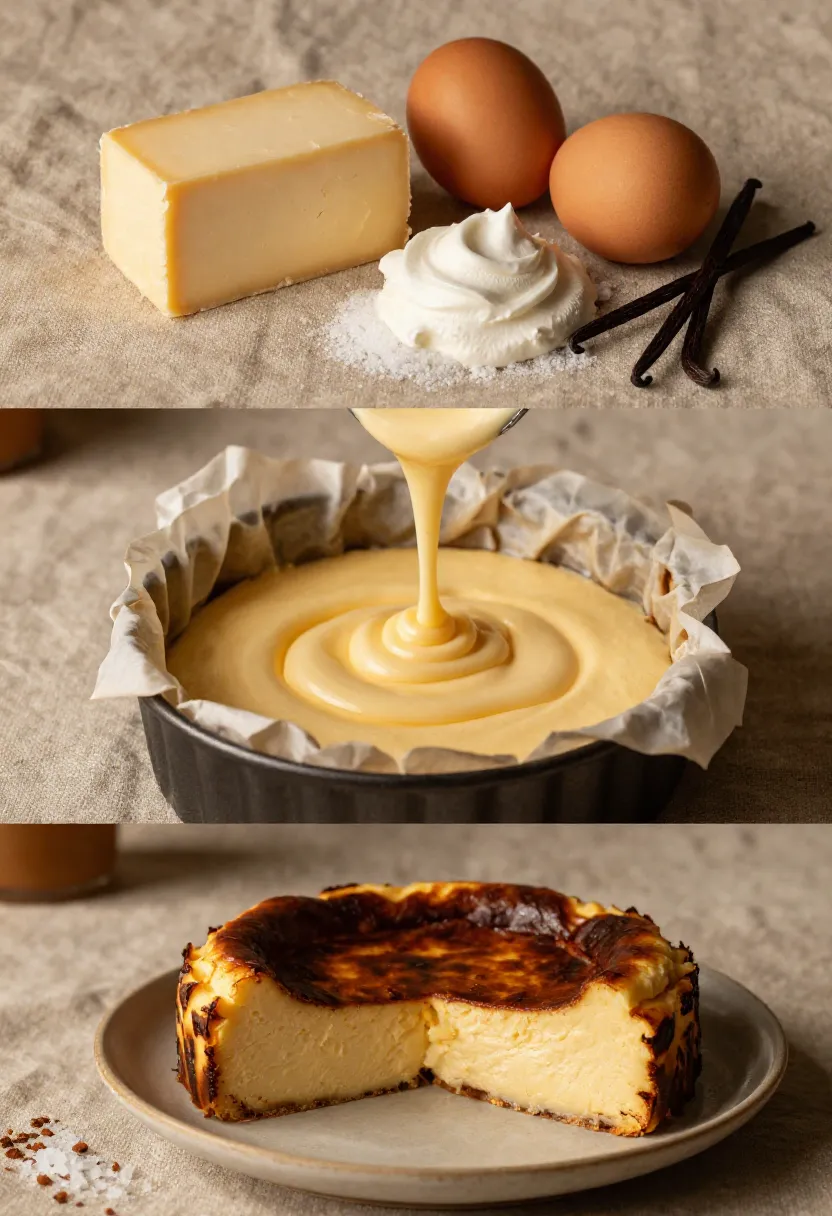
And one more thing: full-fat cream cheese matters. This is not the dessert where low-fat substitutions quietly disappear into the background. The texture changes immediately.
The cheesecake becomes thinner, less creamy, and slightly grainy around the edges.
Not terrible. Just… less magical.
Another small detail that changes the final result is baking time. Even five extra minutes in the oven can shift the texture from creamy and soft to much firmer and more cake-like. That’s why Basque cheesecake recipes often look slightly different from one bakery to another.
Some versions have almost molten centers that spread slightly onto the plate after slicing. Others hold their shape neatly while still staying creamy inside.
Both are technically correct.
That’s part of what makes this dessert interesting to bake repeatedly. You start adjusting little things naturally over time — darker top, softer center, extra vanilla, maybe a little citrus zest. The recipe slowly becomes your own version instead of something copied exactly from a restaurant menu.
And honestly, desserts that leave room for personality usually end up becoming the ones people make again and again. 🍮
Basque burnt cheesecake recipe 🍮
This Basque burnt cheesecake recipe creates a deeply golden top with a rich, creamy middle that stays slightly soft after baking. It’s rustic, dramatic, and surprisingly simple to make at home.
Unlike classic cheesecake recipes that focus on perfectly smooth tops and firm slices, Basque cheesecake leans into a more relaxed, almost imperfect style of baking. The edges rise high in the oven, the parchment paper wrinkles around the sides, and the center settles naturally as the cheesecake cools. What comes out of the oven looks slightly chaotic at first glance, but that contrast is exactly what makes the dessert so memorable.
The flavor changes with every layer too. The dark top develops deep caramel notes with a subtle bitterness that keeps the cheesecake from tasting overly sweet. Underneath, the filling stays silky and rich, almost somewhere between baked cheesecake and vanilla custard. The closer you get to the center, the softer and creamier the texture becomes.
One of the best things about Basque cheesecake is that it doesn’t need much to feel special. No crust. No complicated toppings. No delicate decorating techniques. A simple slice on a plate with coffee or a small spoonful of berries already feels complete.
It’s also the kind of dessert that somehow tastes even better after sitting in the fridge overnight. The texture settles, the caramel flavor deepens, and the slices become smoother without losing that creamy middle. Some people even prefer eating it cold straight from the refrigerator the next day because the contrast between the chilled center and the caramelized top becomes even stronger.
And despite looking bakery-level impressive once sliced, the recipe itself is surprisingly forgiving. Cracks don’t matter. Uneven edges don’t matter. Even the slightly sunken center is part of the charm.
Honestly, that might be why so many people end up baking it again after the first attempt. 🍰
Ingredients
- 2 pounds full-fat cream cheese, softened
- 1 1/3 cups granulated sugar
- 5 large eggs
- 1 1/4 cups heavy cream
- 2 teaspoons vanilla extract
- 1 teaspoon fine sea salt
- 1/4 cup all-purpose flour
Optional toppings:
- flaky sea salt
- fresh berries
- caramel sauce
- espresso
- orange zest
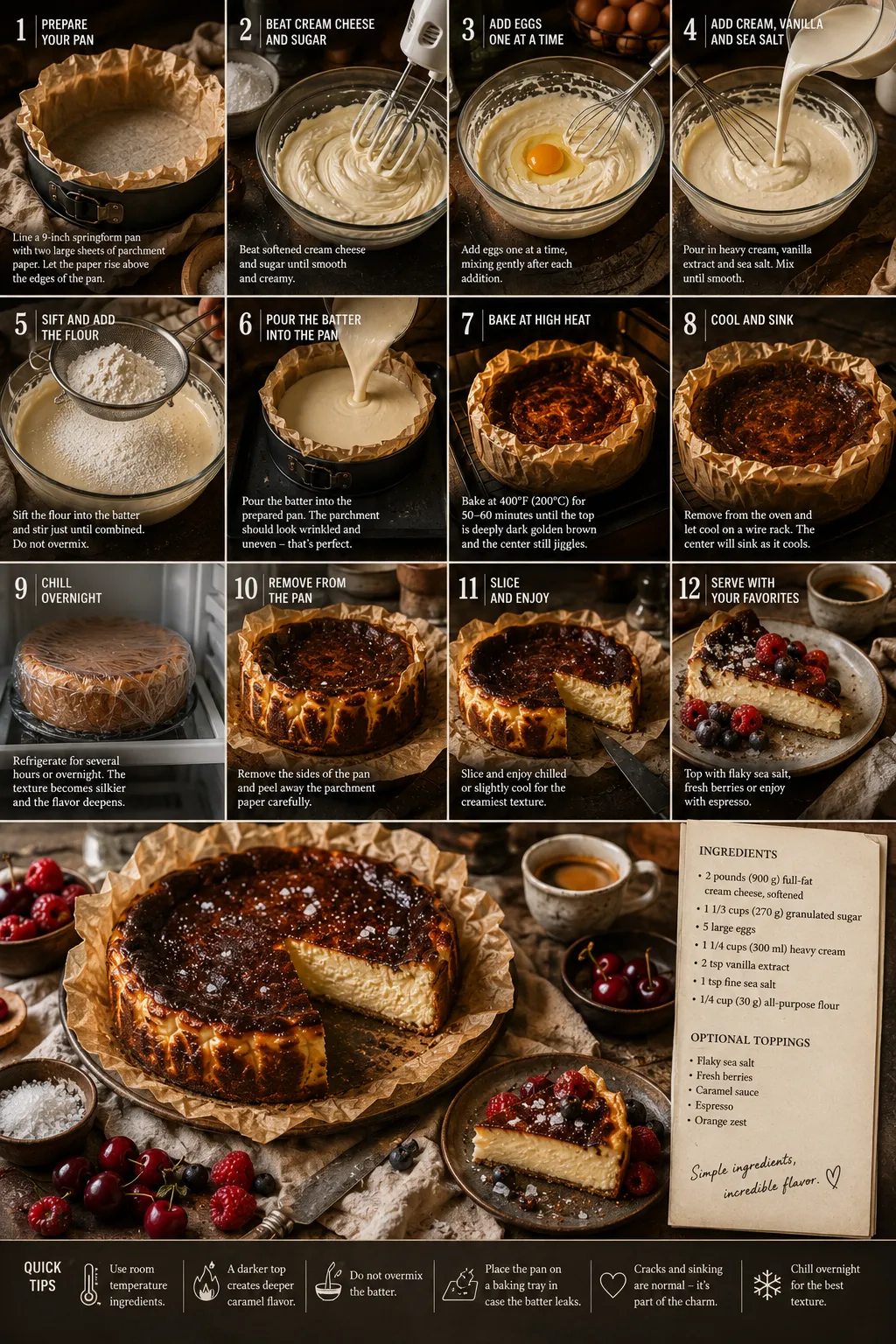
Step-by-step cooking instructions 👩🍳
- Preheat the oven to 400°F (200°C). Line a 9-inch springform pan with two large overlapping sheets of parchment paper. Let the paper rise above the edges of the pan because the cheesecake expands significantly during baking.
- Place the softened cream cheese and sugar into a large mixing bowl. Beat until the mixture becomes completely smooth and creamy with no visible lumps remaining.
- Add the eggs one at a time, mixing gently after each addition. Scrape down the sides of the bowl occasionally so the batter stays even.
- Pour in the heavy cream, vanilla extract, and sea salt. Continue mixing on low speed until smooth.
- Sift the flour into the batter and stir carefully just until combined. Avoid overmixing because too much air changes the final texture.
- Pour the batter into the prepared springform pan. The parchment paper will look wrinkled and uneven — that’s exactly how it should look.
- Bake for 50–60 minutes until the top becomes deeply dark golden brown while the center still jiggles slightly when moved.
- Remove the cheesecake from the oven and place it on a wire rack. The center will sink gradually as it cools.
- Let the cheesecake cool fully at room temperature before slicing. For a firmer texture, refrigerate for several hours or overnight.
- Serve chilled or slightly cool with flaky sea salt or berries on top.
Small baking tips that make a huge difference ✨
- Use room temperature ingredients for a smoother batter.
- Don’t panic if the cheesecake cracks or sinks slightly.
- A darker top creates better caramel flavor.
- Place the pan on a baking tray in case the batter leaks.
- Chill overnight if you want cleaner slices.
Why the texture is the reason people keep coming back to Basque cheesecake 🍮
The texture is what separates Basque cheesecake from almost every other cheesecake recipe. The flavor matters too, obviously, but the real reason people become slightly obsessed with this dessert is the contrast between the dark caramelized top and the soft creamy middle.
The surface develops a deep golden-brown layer during baking that tastes slightly bitter in a way that balances the richness underneath. Under that top layer, the cheesecake stays smooth and creamy, especially near the center. Depending on the baking time, the middle can feel anything from silky and soft to almost custard-like.
That contrast keeps the cheesecake interesting all the way through the slice. The edges are slightly firmer, the top has more caramel flavor, and the center stays softer and richer.
Classic cheesecake can sometimes feel dense after a few bites. Basque cheesecake still tastes rich, but the texture feels lighter because the filling stays softer and less compact. The high oven temperature helps with that too. The cheesecake bakes quickly enough to darken the outside while keeping the center creamy.
Another thing people notice quickly is how much the texture changes after chilling. Fresh from the oven, the middle looks almost underbaked. After several hours in the fridge, it settles into a smoother texture that slices more cleanly while still staying creamy inside.
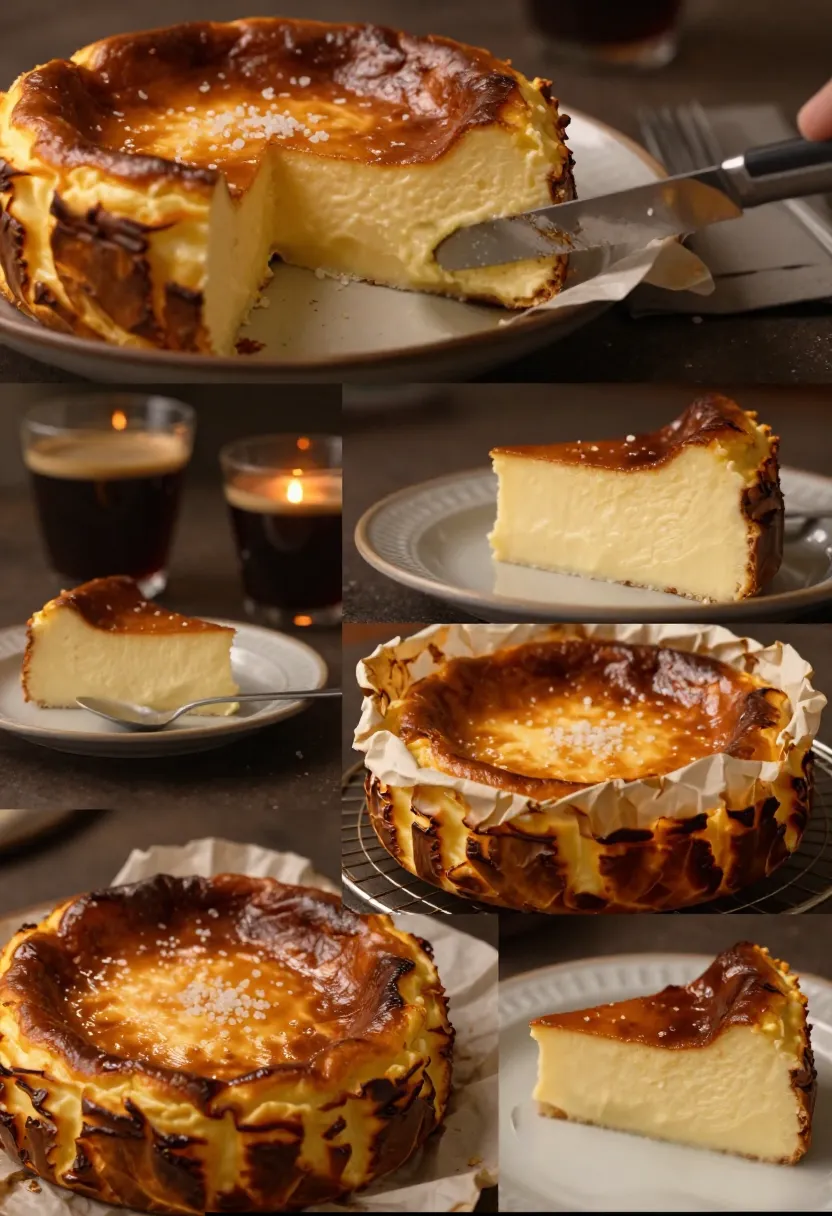
I honestly didn’t expect the overnight difference to be that noticeable the first time I made it. The cheesecake tasted good warm, but the next day it tasted more balanced somehow. Richer, but also smoother.
A few details make the texture stand out compared to traditional cheesecake:
- the center stays softer than classic baked cheesecake
- the caramelized top adds contrast instead of extra sweetness
- the edges become slightly firmer while cooling
- the filling stays creamy even after chilling overnight
- there’s no crust interrupting the texture
The lack of crust actually changes more than people expect. Without a cookie base, the entire focus stays on the filling itself. Every bite feels smooth from start to finish, especially near the middle where the cheesecake becomes almost spoon-soft.
Temperature changes the experience too. Cold Basque cheesecake feels denser and silkier, while slightly warmer slices become softer and creamier. Some people prefer it straight from the fridge, others like letting it sit at room temperature for fifteen or twenty minutes before serving.
Both versions work. It mostly depends on whether you want the texture to feel firmer or softer that day.
The top layer matters more than people realize too. If the cheesecake stays too pale, the flavor ends up flatter and sweeter overall. The darker surface gives the dessert depth and keeps the richness from becoming overwhelming after a few bites.
And despite how rich the ingredients are, Basque cheesecake rarely feels heavy in the same way traditional cheesecake sometimes can. That balance between caramelization and creaminess is probably the main reason people keep making it once they try it the first time. ✨
Basque cheesecake works surprisingly well for gatherings and holidays 🍷
Some desserts create unnecessary stress the moment guests arrive. Frosting starts melting, decorations shift around, or the timing becomes awkward because everything needs to be assembled at the last second.
Basque cheesecake is much easier to live with.
You can bake it the day before, leave it in the fridge overnight, and it actually improves while resting. The texture settles, the flavor deepens slightly, and the cheesecake slices more cleanly once chilled.
That alone makes it one of the more practical desserts for dinner parties or holidays.
The appearance helps too. Basque cheesecake is supposed to look rustic. The wrinkled parchment paper, uneven surface, darker spots on top, and slightly sunken center all make the dessert feel homemade in a good way instead of unfinished.
People usually ask about the dark top immediately when they see it for the first time. Then they try a bite and understand why it’s baked that way.
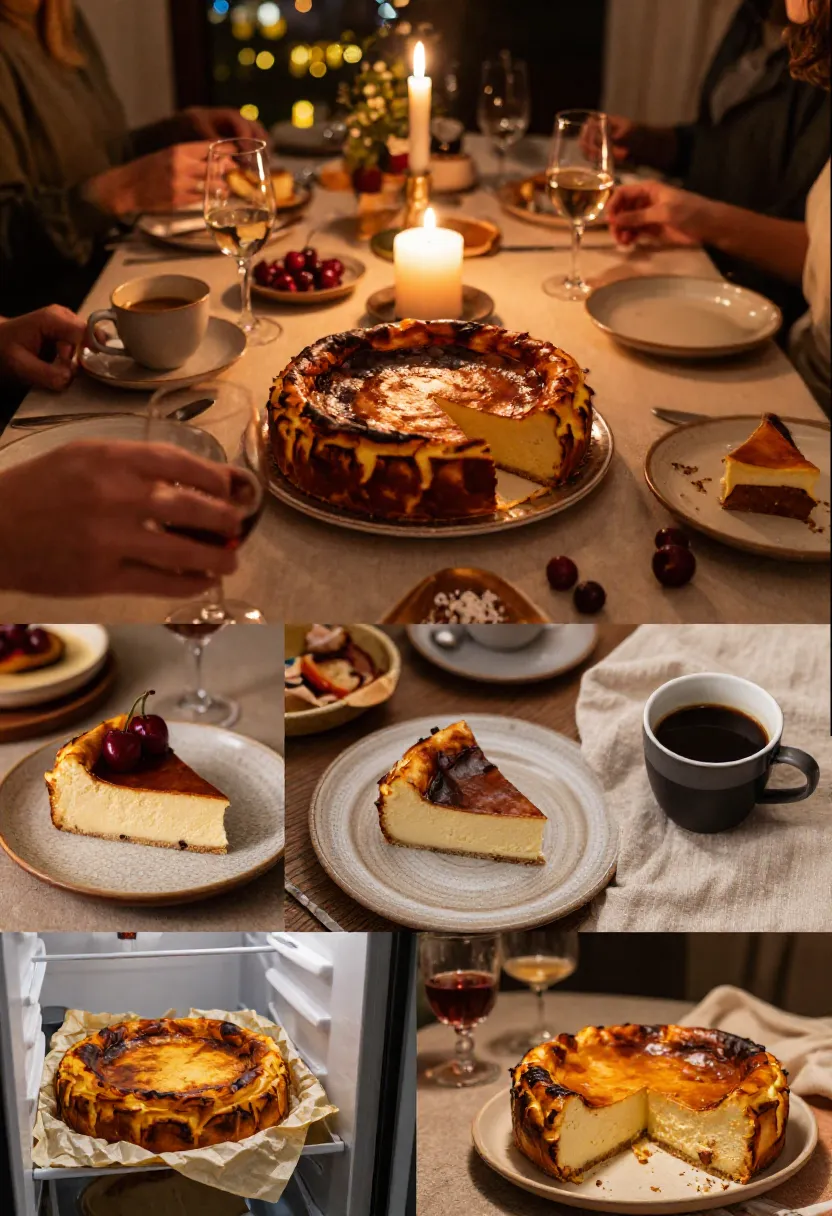
It also doesn’t need much decoration to feel complete. A simple slice on a plate already looks good because the contrast between the dark top and creamy center does most of the work visually.
A few things pair especially well with Basque cheesecake:
- espresso or strong coffee ☕
- fresh raspberries or strawberries
- cherry compote
- flaky sea salt
- dessert wine or sherry
I’ve also noticed that people who normally say cheesecake feels “too heavy” tend to like Basque cheesecake more. The texture stays softer and less dense, especially if the center is slightly underbaked.
Another advantage is that the cheesecake holds up well in the fridge for several days without drying out. Some cakes lose texture overnight, but Basque cheesecake usually becomes smoother after resting.
That flexibility makes hosting easier. You don’t need to bake it at the last minute or worry about careful assembly before serving.
It’s also one of those desserts that works in different settings without feeling out of place. It can feel casual with coffee on a weekend afternoon or slightly more elegant after dinner with wine and fruit.
And because the recipe doesn’t depend on perfect presentation, people tend to relax around it more. Nobody expects flawless slices or polished decoration. The cheesecake already looks the way it’s supposed to look.
Honestly, that’s part of the appeal.
The best thing about Basque cheesecake might be how forgiving it is 🍰
A lot of baking recipes quietly assume you’re aiming for perfection. Perfect decoration, perfect timing, perfectly smooth surfaces.
Basque cheesecake doesn’t really work that way.
The parchment paper can wrinkle. The top can crack. The center can sink while cooling. The surface can darken unevenly. None of those things ruin the cheesecake. Most of them actually improve the final result.
That changes the entire baking experience.
Traditional cheesecake recipes often come with long instructions about water baths, cooling methods, cracking prevention, and exact baking temperatures. Basque cheesecake is much more relaxed by comparison. You still need to pay attention to texture and color, but small imperfections stop feeling like disasters.
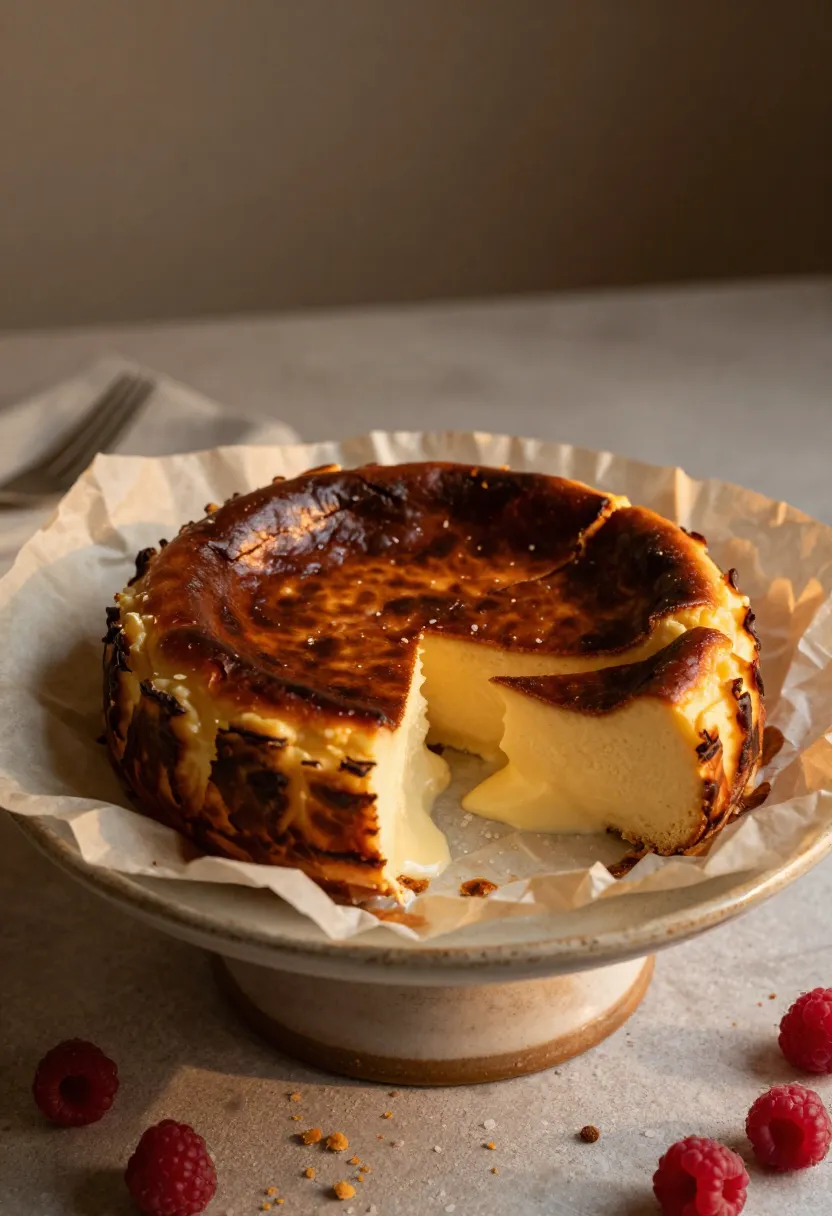
The first time the center sinks after baking, it can look alarming if you’re used to traditional cheesecake. But that slightly collapsed middle is exactly what creates the creamy texture people want.
Even the messy parchment paper becomes part of the final appearance. Those uneven folds around the edges help give Basque cheesecake its recognizable shape.
A few things that matter far less than people think:
- perfectly smooth parchment paper
- tiny cracks on the surface
- slightly uneven browning
- perfectly straight slices
- completely level batter
The cheesecake still looks impressive because the texture and flavor carry everything else.
I think that’s one reason so many people keep returning to this recipe. It feels achievable. You don’t need advanced decorating skills or complicated techniques to make something that tastes genuinely special.
And the recipe leaves room for personal preference too. Some people bake it longer for a firmer center. Others prefer a softer middle that almost spreads onto the plate after slicing. Some add citrus zest or vanilla, while others keep the flavor completely simple.
The cheesecake adapts easily without losing what makes it recognizable.
That flexibility makes it feel more personal over time. After making it once or twice, most people naturally start adjusting little details to match the texture they like best.
And honestly, desserts that allow a little imperfection usually end up feeling more human in the end. ✨